A note of acknowledgement
We would like to thank the many people who contributed to this investigation in what was a short timeframe. Staff across provider organisations, integrated care boards and national bodies made themselves available to the investigation. In particular, we are grateful for the extent of evidence shared by those working in general practice.
About this report
This report is an interim publication as part of HSSIB’s focus on electronic patient record systems – electronic referrals for ongoing care. In light of concerns about patient safety heard by HSSIB, this report focuses on advice and guidance (A&G) services in the NHS in England, which enable clinicians in general practice to seek specialist advice from secondary care. It also considers where A&G services are used as part of single point of access (SPoA) models.
This report is intended for healthcare policy makers to help influence improvements in patient safety. It is also intended for those who work in and engage with providers of general practice and secondary care, including integrated care boards.
The following are provided as framing to this report and are important to note:
- A&G services have been established in parts of the NHS for more than 10 years. Their use has continued to expand and is now aligned with SPoA models. The investigation heard strong support for A&G services and the benefits they provide for many patients where they have been implemented effectively. HSSIB also heard specific concerns about patient safety with plans to expand A&G/SPoA, which led to the focus of this investigation.
- The purpose of this report is to support the safe implementation and expansion of A&G/SPoA processes. It was not the role of the investigation to examine the rationale for implementation or the risks associated with not expanding A&G/SPoA. The investigation acknowledges that patients are experiencing harm as a result of delays in accessing specialist care and that A&G/SPoA is being implemented to manage risks within current processes.
- A recurring concern shared by stakeholders was that A&G had been, and was being, “mandated” across the NHS. NHS England has clarified that A&G was never intended to be mandated to prevent access to the making of referrals (see 3.1.6). NHS England has published further clarification that A&G is not a mandatory step before referral, that the clinical threshold for referral must remain unchanged, and that there is no national target to divert referrals away from specialist assessment.
- The local implementation and expansion of A&G/SPoA vary across the country. Throughout the investigation, NHS England shared draft guidance, publications and resources intended to support implementation (see 3.1.17). NHS England is also commissioning an external evaluation of A&G and SPoA, which incorporates lines of enquiry relating to patient safety and health inequalities.
- The investigation found variation in the terminology used to describe A&G, SPoA and referral management processes. To support consistency and understanding, a glossary is provided in section 4.
Executive summary
Background
This report examines the patient safety risks associated with advice and guidance (A&G) services between general practice and secondary specialist care. A&G services enable clinicians in general practice to seek specialist advice about a patient’s care, either before or instead of referring them to hospital for specialist assessment. A&G is often undertaken via the NHS electronic referral service (e-RS), a digital platform also used for referring patients to NHS hospitals.
The use of A&G services has increased significantly in recent years. Concerns were raised with HSSIB that further plans for expansion and prioritisation of A&G, including as part of single point of access (SPoA), created risks to patient safety. SPoA is a model where all A&G requests and elective referrals (other than those for urgent suspected cancer) are directed into a single digital entry point at specialty level within secondary care.
The investigation
The investigation explored evidence of the patient safety risks associated with A&G services and their role in SPoA. It included engagement with general practice and secondary care providers, integrated care boards (ICBs) and national bodies. The exploration also considered the implementation of A&G processes, how A&G works with the e-RS, and oversight of patient care pathways.
Findings
- A&G services had positively influenced patient care where they had improved communication between general practice and specialist services, and enabled efficient specialist input into care. There was limited data on outcomes relating to patient safety.
- There was evidence that A&G – due to how it had been implemented, integrated into processes, and/or was monitored – had contributed to near misses and incidents of patient harm, both physical and psychological. Harm had arisen as a result of delayed or missed diagnoses, and delays to care and treatment.
- Evidence demonstrated that A&G services were being used in some pathways where general practice had requested specialist assessment for suspected cancer. Incidents demonstrated that this had contributed to delays in diagnosis.
- The extent of the risk to patient safety of A&G/SPoA processes could not be determined, due in part to limitations in safety data. Incidents identified in general practice were not consistently reported to the Learn from Patient Safety Events service due to technical barriers and limitations in local reporting processes.
- There were gaps between how A&G/SPoA processes had been and were being implemented, and national expectations. Examples included local pathways that required GPs to use A&G instead of making direct referrals, and referrals for specialist assessment being declined despite GPs having persistent concerns.
- There was tension between national timeframes for the implementation of A&G/SPoA processes, and the capability and capacity of providers and ICBs to ensure that implementation and expansion managed risks to patient safety.
- ICBs have a significant role in supporting the co-design, implementation and oversight of A&G/SPoA processes. Challenges facing ICBs, and the effectiveness of some of their interface groups (or equivalent), affected their ability to provide this support.
- While most specialist responses to A&G requests occurred within expected timeframes, there were repeated examples of delays ranging from weeks to more than 6 months. The quality of requests and responses also varied, with limited standardisation in the structure of information shared.
- Issues with the functionality and usability of the e-RS, and its interoperability with other health IT systems, affected users’ ability to consistently share high-quality information, and monitor and track patients through pathways. Planned upgrades to the e-RS had been delayed at the time of writing.
- Providers deploying e-RS were unable to provide evidence that compliance with digital clinical risk management standards (DCB0160) had been achieved. Deployment of e-RS into local pathways, and the associated risks, had not been assessed.
- Further concerns relating to the implementation of A&G/SPoA processes had not been fully addressed by national stakeholders or through local co-design. These included clarification of what constitutes a ‘clinically appropriate’ referral, concerns about medicolegal accountability, addressing resource and training needs, and ensuring that GPs retain the right to refer.
HSSIB makes the following safety recommendations
Safety recommendation R/2026/095:
HSSIB recommends that NHS England/Department of Health and Social Care undertakes a rapid evaluation of advice and guidance processes, including as part of single point of access. This is in order to address the varying risks to patient safety created by the:
- resource and capacity limitations of integrated care boards and providers, and their ability to support implementation and oversight of processes
- varying effectiveness of interface groups, and their ability to support collaboration between general practice and secondary care
- training needs of the multidisciplinary workforce to undertake safe and effective asynchronous consultations
- limitations in risk identification and mitigation associated with the deployment of the electronic referral service into local pathways, in line with standards
- gaps in reporting of patient safety incidents by general practice to inform understanding of patient harms and risks to patient safety.
Completing this evaluation and addressing findings before further expansion of advice and guidance processes, including as part of single point of access, would ensure risks to patient safety have been identified, assessed and managed.
Safety recommendation R/2026/096:
HSSIB recommends that NHS England/Department of Health and Social Care, in collaboration with relevant Royal Colleges:
- commissions the development of advice and guidance request and response templates for specialties where these do not exist, including general practice
- supports effective implementation of template use in practice.
This is to support greater standardisation in the electronic clinical information provided when advice is sought from and provided by specialists.
HSSIB makes the following safety observations
Safety observation O/2026/091:
Organisations involved in the design and provision of healthcare education can improve patient safety by addressing gaps in knowledge and skill across the multidisciplinary workforce for the undertaking of asynchronous clinical consultation tasks, such as those undertaken through advice and guidance services.
Safety observation O/2026/092:
Organisations can improve patient safety by ensuring the mandated requirements for digital clinical risk management (under DCB0160) for the deployment of the electronic referral service (e-RS) are achieved. For general practices and integrated care boards this includes agreeing responsibilities for the digital clinical risk management of e-RS. This is to enable identification and mitigation of risks to patient safety associated with e-RS when implemented into care pathways.
HSSIB suggests safety learning for integrated care boards
HSSIB investigations include safety learning for integrated care boards where this may help organisations think about how to respond to a patient safety issue that relates to integrated care across a geographical footprint. Informed by the findings in this report, the investigation proposes the following safety learning.
Safety learning for integrated care boards ICB/2026/021:
HSSIB suggests that integrated care boards (ICBs) – through co-design with general practice, secondary care and people with lived experience – ensure that the following are considered as part of advice and guidance (A&G) and single point of access (SPoA) processes:
- alignment with national expectations, including ensuring that suspected cancer referrals are managed appropriately, and that formalised pathways are established for referral where general practice remains concerned that specialist assessment is clinically appropriate despite a referral being declined.
- clarification of the concept of ‘clinically appropriate’ within local referral pathways, including the establishment of mechanisms by which clinicians can resolve differences in clinical opinion to support collaborative care planning.
- clarification of the roles and responsibilities of different providers along patient care pathways where care is transferred, shared or informed by specialist advice.
- ICB role in digital clinical risk management of deployed systems for A&G/SPoA, including support to general practice to understand local implementation risks.
- clinical information sharing through interoperable health IT systems, alongside the use of standardised templates where appropriate.
- oversight of the quality and safety of A&G/SPoA processes, including monitoring of patient safety incidents, the quality and timeliness of A&G responses, and redirection rates where referrals are responded to with advice.
Local-level learning
HSSIB investigations include local-level learning where this may help provider organisations respond to a patient safety issue at the local level. Informed by the findings in this report, the investigation shares the following local-level learning.
For providers involved in advice and guidance (A&G) or single point of access (SPoA) processes:
- How does your organisation ensure that the design and implementation of processes between providers are informed by effective co-production and engagement with providers, the multidisciplinary workforce and patients?
- Does your organisation have clarity on roles and responsibilities within A&G/SPoA processes, including who is responsible for undertaking clinical investigations, interpreting results and prescribing following specialist advice?
- How could your organisation improve interoperability between health IT systems to support access to, and the flow of, patient information, for example between the electronic referral service and an electronic patient record?
- Has the deployment of the electronic referral service in your organisation been assessed against digital clinical risk management standards (DCB0160) to identify and manage potential risks to patient safety?
- How does your organisation monitor the quality and timeliness of A&G requests and responses, and ensure that they are received and acted on?
For general practices:
- How does your organisation ensure that requests for A&G are structured appropriately and clearly articulate the ‘ask’ (clinical question) to support specialists in understanding the purpose of the request?
- How does your organisation ensure that patient safety incidents involving A&G/SPoA processes or the electronic referral service are reported and escalated, including through the Learn from Patient Safety Events service?
- How does your organisation escalate concerns to the specialist teams when there are delays or questions about the advice received?
For secondary care organisations and specialists:
- Does your organisation use A&G/SPoA processes outside of stated national expectations and does your organisation ensure cancer care is not impacted?
- How does your organisation ensure that responses to A&G requests are structured to support ongoing patient care, including with the provision of safety-netting information?
- How does your organisation ensure that A&G requests are responded to by staff with appropriate training and supervision, in line with national expectations?
- Does your organisation provide protected time within job plans for reviewing and responding to A&G requests, including consultant supervision of staff undertaking this work?
- How does your organisation monitor the responsiveness of specialties to A&G requests and the quality of information shared to provide oversight of the safety and effectiveness of these processes?
1. Background and context
This section provides the background to the launch and scope of this investigation, and provides information about advice and guidance services, and associated digital systems and patient safety issues.
1.1 Investigation approach
1.1.1 This investigation was undertaken as part of HSSIB’s examination of electronic patient record systems – electronic referrals for ongoing care. The investigation was launched in response to concerns about risks to patient safety associated with the prioritising of advice and guidance (A&G) services across the NHS.
1.1.2 This investigation focused on asynchronous A&G services (see 1.2.1) between general practice (under General Medical Service contracts) and NHS specialist consultant-led, acute services (referred to in this report as secondary care) when seeking pre-referral specialist advice. It also considered single point of access (SPoA, see 1.2.4) models for requests and referrals to secondary care providers. Further detail on the investigation approach can be found in the appendix.
1.2 Advice and guidance services
1.2.1 NHS England (2026a) describes pre-referral A&G as a route to support clinical dialogue between clinicians in primary care (such as general practice) and specialist clinicians ‘prior to, or instead of referral about a named patient’ (NHS England, 2026a). A&G services involve non-face-to-face activity delivered by consultant-led services which can be synchronous (for example, via a telephone call) or asynchronous (via the NHS’s electronic referral service (e-RS), other agreed IT platforms or email).
1.2.2 The benefits of A&G services are described to be multiple, and case studies demonstrate positive impacts including reductions in unnecessary outpatient appointments. Benefits include (NHS England, 2025a):
- quicker access to specialist advice and tests/treatments
- reduced unnecessary hospital appointments and more patient choice
- educational insights for clinicians to guide future care of patients
- reduced demand on outpatient services and greater cost effectiveness.
Evolution of advice and guidance services
1.2.3 Since the introduction of A&G services in 2015, there have been policy changes aimed at increasing their use (see table 1 for key changes during 2025 and 2026). Since the COVID-19 pandemic, and in support of getting elective (planned rather than emergency) services back on track after COVID, A&G services have become more embedded. The number of pre-referral requests doubled between April 2022 and February 2026, when around 300,000 requests were made (NHS England, 2026b).
Table 1 Key publications related to advice and guidance, 2025 and 2026
| April 2025 – enhanced service | NHS England (2025b) launched an enhanced (additional) service option for general practices for 2025/26. This aimed to increase use of specialist A&G prior to, or instead of referral. Practices received £20 per request. |
|---|---|
| April 2025 – operational delivery framework | NHS England (2025c) published an integrated care board (ICB) framework for A&G. ICBs were required to use the framework to understand regional progress and to inform discussion about delivery across primary and secondary care. |
| October 2025 – medium-term planning framework | NHS England (2025d) published a planning framework for 2026/27 to 2028/29. It included prioritising A&G ‘prior to, or instead of, a planned care referral where clinically appropriate (excluding referrals for urgent suspected cancer)’ and that there ‘should be a move to all referrals going via Advice and Guidance’ for a selected 10 specialties at provider level which have the most potential for this model to be effective. Expectations for SPoA were also described. |
| February 2026 – end of consultation of the GP Contract 2026/27 | NHS England (2026c) published a letter describing proposed changes to the GP Contract for 2026/27. This included embedding the A&G enhanced service funding into core practice funding, and that ‘Practices will be required to use Advice and Guidance prior to or in place of a planned care referral where clinically appropriate and to follow locally agreed referral pathways, including single point of access models once introduced’. |
| April 2026 – clarifying plans |
NHS England (2026d) published a further letter explaining the plans for A&G and SPoA, and what general practice should expect from secondary care. The letter clarified that: - there is no national target for diversion of referrals away from hospital care - a GP’s decision to refer remains unchanged, and if having received advice they remain concerned that a referral is clinically appropriate, there should be a route for referral - certain operational standards should be expected including 5 working days for a response from a named consultant, and that if specialist assessment identifies the need for diagnostic tests as part of the specialist pathway, those tests should be organised and results reviewed and acted on by secondary care. |
| June 2026 – amendments to the GP Contract | Amendments to The National Health Service (General Medical Services Contracts and Personal Medical Services Agreements) (Amendment) Regulations, 2026 came into force. These included that ‘The contractor must, where clinically appropriate, comply with any relevant referral pathways notified under paragraph (1), prior to referring a patient for services under the Act’. Referral pathways include arrangements such as A&G. |
| Further publications | At the time of writing, further publications to support A&G and SPoA were being prepared by NHS England. These included updated technical guidance and a clinical toolkit. |
Single point of access
1.2.4 Elective SPoA is defined by NHS England (2026a) as ‘a model where all Advice and Guidance requests and elective referrals (other than those for urgent suspected cancer), are directed into a single digital entry point at specialty or sub-specialty level within secondary care’. Clinical review of the ‘enquiries and referrals’ is then undertaken to determine ‘the most clinically appropriate next step(s) or outcome for the patient’. Figure 1 shows the elective SPoA process and the position of A&G.
Figure 1 Summary of the elective single point of access process, adapted from NHS England (2026a)
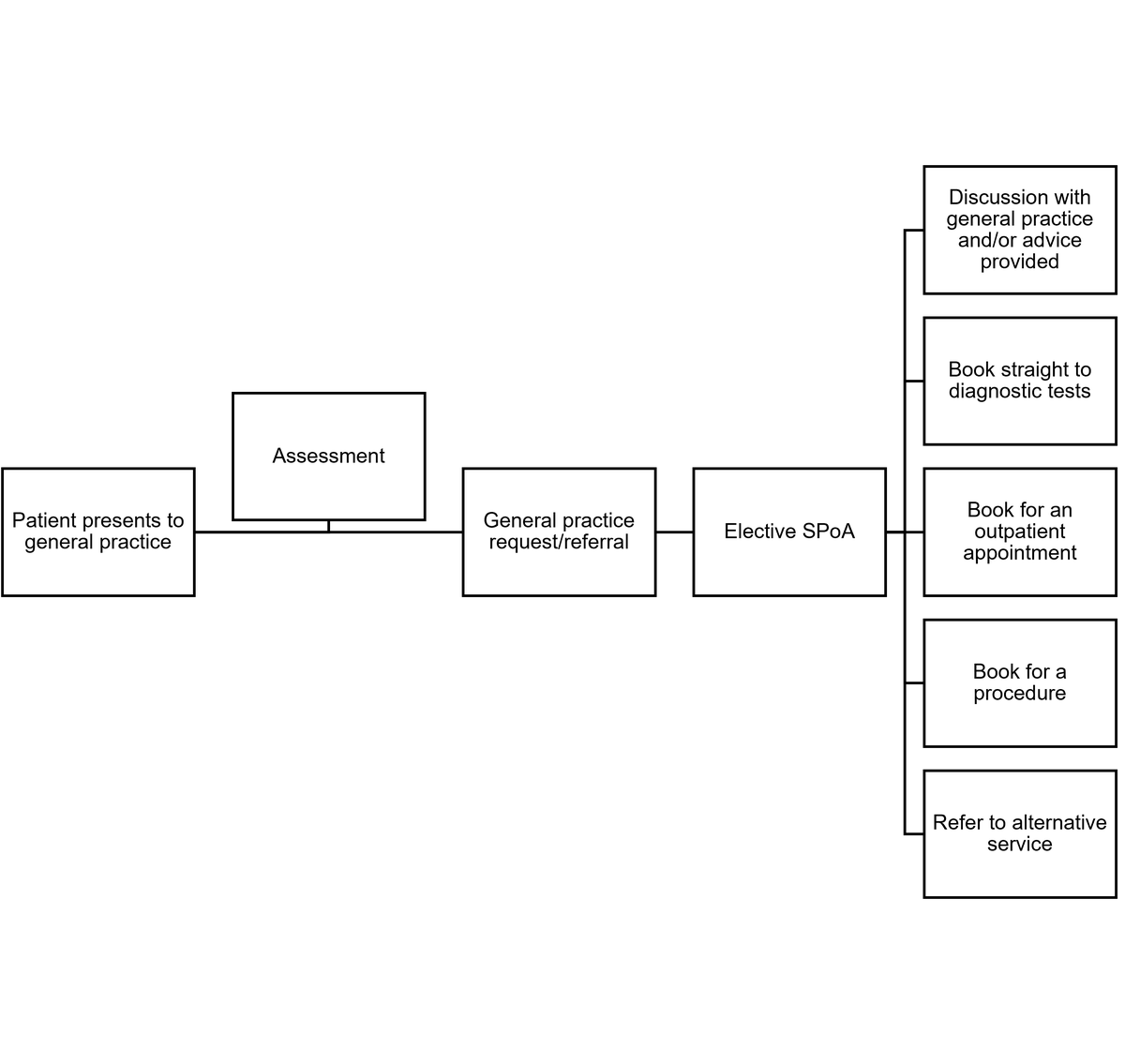
1.2.5 NHS England (2026a) published accompanying technical guidance for elective SPoA for 2026/27; this was being updated at the time of writing. This guidance described expectations and priorities for providers and ICBs. Expectations included in version 1.0 of the guidance were:
- ‘All NHS providers of consultant-led care are to prioritise Advice and Guidance, as a tool for specialist input, across their 10 priority specialties as of 1 April 2026 …’
- ‘All providers are to implement elective SPoA by the start of October 2026, starting with the 10 specialties prioritised for A&G and extending to other specialties and sub-specialties.’
- ‘Providers must work towards achieving’ timeframe standards for processing of A&G (5 working days), routine referrals (5 working days) and urgent referrals (2 working days).
- ‘Consultant-led, multi-professionally delivered clinical review of general practice enquiries and referrals is undertaken …’
- ‘Advice and Guidance should not be used in place of an Urgent Suspected Cancer referral …’.
1.3 Associated systems and processes
Electronic referral service (e-RS)
1.3.1 e-RS is a web-based digital platform for referring patients to specialist providers. It is supplied by NHS England (2026e). e-RS provides functionality for creating referrals, having A&G conversations and creating reports for oversight. It is possible to access e-RS functionality or data through another system, such as an electronic patient record, where an interface is created using an API (application programming interface).
1.3.2 The NHS Standard Contract (2026) requires that e-RS is used for all referrals from general practice to NHS secondary care outpatient services. Priorities for 2026/27 also included moving to e-RS for all A&G requests and referrals from general practice (excluding urgent suspected cancer), and improvements in e-RS functionality to support elective SPoA are expected from October 2026 (NHS England, 2026a).
Digital clinical risk management
1.3.3 The NHS England (2018a; 2018b) digital clinical risk management standards (DCB0129 and DCB0160) provide frameworks for identifying, assessing and managing clinical risks throughout the lifecycle of health IT systems. They recognise that risks arise from how a system is built and from how it is implemented and used. Compliance with these standards is mandated under the Health and Social Care Act 2012; the standards were under review at the time of the investigation.
1.3.4 The standards include requirements for suppliers/organisations to have a suitably qualified clinical safety officer and to maintain a clinical risk management file for a health IT system. That file must include a risk management plan, hazard log and clinical safety case. The clinical safety case presents evidence that a system is safe for a given application in a given environment at a defined point in its lifecycle (NHS England, 2025e).
1.3.5 DCB0129 applies to health IT system manufacturers/suppliers and requires them to design and develop systems in a way that anticipates and mitigates potential safety hazards (NHS England, 2018a). DCB0160 applies to organisations deploying and using health IT systems, requiring them to ensure that the system is safe in the context of local workflows, configuration, and use in practice (NHS England, 2018b). DCB0129 requires the manufacturer/supplier to make available each clinical safety case to deploying organisations, with inclusion of the hazard log, to aid in local risk analysis.
Learn from patient safety events
1.3.6 The Learn from Patient Safety Events (LFPSE) service is a national system for the recording of patient safety events (NHS England, 2026f). Some providers have LFPSE-compliant systems for recording events locally, which also enter those records into LFPSE. Providers without compliant systems record events directly onto LFPSE using the online service.
1.3.7 The interface between local recording systems in secondary care and LFPSE is well established. NHS England’s (2024) Primary Care Patient Safety Strategy has described the culture of event recording from primary care as ‘underdeveloped’ and has therefore set out objectives for ICBs to support adoption of LFPSE, including in general practice.
2. Analysis and findings – patient outcomes and clinical processes
The investigation examined the actual and potential harms associated with advice and guidance (A&G) processes, and how those processes functioned in practice. This section summarises relevant findings.
2.1 Patient outcomes
2.1.1 The investigation heard from clinicians that most A&G encounters had a positive influence on patient outcomes. In several areas, A&G was described to have enabled quicker access to specialist input, shorter waiting times, and strengthened relationships between specialist providers and general practice. Most clinicians were supportive of A&G services where they had been implemented through collaboration between general practice and secondary care, were well governed, and were appropriately resourced.
2.1.2 In general practice, clinicians described how A&G was supportive when specialist responses were timely, clearly answered a clinical question, and included ‘safety net’ advice if care did not progress as expected (see box 1). A&G services were also useful for seeking advice when patients were already waiting to see a specialist.
Box 1 General practice experience of advice and guidance (A&G)
‘I do like the improved communication that comes with A&G. It is great to be able to connect quickly with a specialist for some advice to support ongoing management in primary care. I have received some extremely helpful and detailed responses which have helped me to manage a patient quickly and control their symptoms.’
Outcomes for patient safety
2.1.3 While several areas and stakeholders described no apparent increase in risks to patient safety associated with the implementation of A&G, the investigation did identify patient safety incidents (see appendix for search details). In these cases, A&G had been used within patient care pathways and was identified as a contributor to patient harm. Incidents were identified through formal reporting mechanisms and via engagement with clinicians and administrative staff. Outcomes included delayed or missed diagnoses, poorer cancer prognosis, avoidable surgery and prolonged symptoms.
2.1.4 The process issues that contributed to patient harm are explored in 2.2. Common issues that arose in A&G processes included the timeliness of specialists’ responses to A&G requests, responding with specialist advice when general practice had assessed that the patient required face-to-face specialist assessment, and where process integration issues did not support onward care of the patient (see box 2 for examples).
Box 2 Examples of incidents involving advice and guidance (A&G) in the care process
Specialist advice delayed – the patient had a history of epilepsy and consulted his GP after experiencing repeated seizures. The GP sent an A&G request for specialist neurology advice. No response was received after 1 month, so the GP sent an urgent referral which was then not responded to for over 6 weeks. While waiting for the urgent referral to be triaged, the patient had a seizure at home and died following a cardiac arrest. HM Coroner concluded that the patient had died as a result of sudden unexpected death in epilepsy. They noted multiple factors impacting on the patient’s care, and referenced the delayed response to A&G and referral.
Report to Prevent Future Death
Repeat referrals managed with advice – a GP sent several referrals for a patient to be seen by a specialist for what they suspected might be a skin cancer. Referrals were described as having to be sent via a mandatory A&G pathway and were responded to with advice on each occasion, based on a supplied photograph. More than 6 months later, the patient was seen and melanoma was diagnosed. The cancer was more advanced than when it was originally suspected by the GP.
Experience of a general practitioner
Intended care not received – the GP requested A&G from urology for haematuria (blood in urine). The specialty converted the A&G to a referral for outpatient review. The clinic considered that further investigations were required by the GP, and that the GP should re-refer the patient on a suspected cancer pathway if needed. Due to referral processing in the specialty organisation, the referral was inadvertently cancelled with neither the GP nor the patient being informed. The patient sought further help 6 months later and was found to have endometrial cancer requiring major surgery.
Patient safety investigation report
2.1.5 Most examples of physical harm were described to the investigation by clinicians. Many were not also recorded in the national Learn from Patient Safety Events service, particularly when identified in general practice. This reporting gap is explored in 3.3 and limited the investigation’s ability to examine the contribution of A&G to some incidents. Several national bodies also described hearing concerns and examples of incidents associated with A&G services from their membership but did not have data about the issues.
2.1.6 For many of the incidents identified, there was no clear evidence of patients’ outcomes. However, the incidents had raised concerns among clinicians or were described as “near misses”. These incidents included where the quality of responses received had not provided a clear course of action, and responsibility for unfamiliar investigatory tests was passed to GPs to undertake, interpret and inform the patient.
2.1.7 Regarding the quality of responses to A&G requests, examples were seen where responses did not provide specific answers to the questions asked, or were described as “obstructive”. Other examples were overly generalised, making it difficult to make a clear plan, or were later revised by a consultant after initial response by a non-consultant member of staff.
2.1.8 The investigation also identified incidents of psychological harm to patients. These were associated with prolonged physical symptoms or poor experiences of care. Examples included anxiety while waiting for responses to requests for advice about symptoms or signs of concern, and patients feeling dismissed when specialists declined to see them. Patients also expressed concerns when they had to “chase up” their care which, in some cases, prompted recognition of a delayed response to A&G by services.
Other outcomes
2.1.9 Although the investigation’s focus was patient safety, it identified evidence of how A&G services influenced different quality outcomes. These included positive and negative impacts on patient experience. For example, The Patients Association (2022) held a series of workshops to explore patient and public perceptions of A&G. The series identified themes, including experiences that A&G created ‘roadblocks’ to care and reduced continuity.
2.1.10 Evidence related to the impact of A&G services on equitable access to care was more limited. Emerging research has suggested that A&G services may contribute to delays in accessing specialist care for people from minority ethnic groups and those experiencing socioeconomic deprivation (Mason et al, 2026). Clinicians in general practice expressed concerns that A&G may exacerbate existing inequalities in access to care for people in vulnerable circumstances. They also considered the potential risk of diagnostic overshadowing without face-to-face specialist assessment.
2.1.11 From a staff perspective, clinicians and administrators described mixed experiences of A&G services. Where services worked well, clinicians said they eased pressures and supported patient care. However, where advice was delayed, perceived as dismissive, or generated additional tasks (as described in 2.2.6), impact on workload and staff wellbeing was described. The risk of burnout was raised and the investigation heard examples of incivility between general practice and secondary care staff.
2.1.12 A&G services may also be having unintended impacts on other parts of the healthcare system. The investigation heard about potential impacts on outpatient capacity as resources are diverted to managing A&G services and single point of access (SPoA), and patients seeking support from emergency departments while awaiting responses to A&G requests. These unintended impacts were not examined further.
Conclusions
2.1.13 The investigation found support for A&G services where prompt specialist advice contributed to positive patient outcomes. The investigation also found:
- examples of physical and psychological harm to patients where A&G services had been identified as contributing to delayed, missed or inappropriate care.
- near misses of harm and concerns that similar conditions may result in patient harm in the future.
2.1.14 The patient safety incidents identified and heard demonstrate how issues with A&G services can contribute to significant patient harm. The number of formally reported incidents over the 3-year period of the search (see appendix) was low compared to the number of incidents described by clinicians and the number of A&G requests during that period. Between 1 January 2023 and 31 December 2025, over 8.5 million pre-referral A&G requests were submitted across England (NHS England, 2026b). Due to the limited availability of safety-related data and under-reporting of incidents, the investigation was unable to determine the extent or likelihood of the risk to patients. Limitations in safety-related data are explored further in 3.3.3.
2.2 Clinical processes
2.2.1 The investigation examined the clinical processes involved in A&G services, including SPoA where it was established, to explore their contribution to the outcomes described in 2.1. The focus was A&G prior to or instead of a referral, but it was also heard that A&G services were used to seek advice for patients who were waiting for specialist assessment.
2.2.2 A&G processes were observed to vary across the country and across specialties in the same provider organisation (see also Getting It Right First Time, 2025a). In general, A&G requests were managed separately, or together with referrals:
- Separately – A clinician in general practice specifically wants advice about a patient. They complete an electronic A&G request. A receiving specialist reviews the request and replies. Where the requestor has pre-authorised them to do so, the specialist may convert the A&G into a referral for assessment.
- Together – Whether a clinician in general practice wants to request advice or make a referral, contact with the specialist team passes electronically through a single pathway. The specialist service ‘triages’ the request and decides on the next step – this may be advice to the general practice clinician (that is, A&G), requesting of further tests, redirection of the patient to another service, or addition of the patient to the specialist waiting list for assessment. This aligns with SPoA shown in figure 1.
Sending requests and referrals
2.2.3 In general practice, A&G requests were completed by a range of clinicians, or administrators when instructed by a clinician. Clinicians were typically GPs but also included nursing and allied health professionals. Most requests were made through the electronic referral service (e-RS), although a third-party system was used in some areas. The sending process was observed to involve multiple steps, including transferring information between systems or between members of staff. The investigation heard that manual processes and limited interoperability between health IT systems created additional work and “opportunities for error”.
2.2.4 The investigation also saw how the quality of information sent to secondary care varied. A&G requests were not standardised and ranged from a short question entered into a free-text box, to a lengthy attached document containing the patient’s full clinical record. Secondary care clinicians described that, in some circumstances, understanding the clinical question could be challenging.
2.2.5 Secondary care clinicians described how the quality of information in A&G requests affected their decision making. In particular, they shared concerns that, when they had not seen a patient face to face, they were relying on another clinician’s assessment, and they faced barriers accessing wider information about the patient through other health IT systems. Concerns were also shared about being accountable for the advice they gave if it contributed to patient harm.
Managing requests and referrals
2.2.6 In line with the different processes seen (see 2.2.2), the handling of A&G requests when received by secondary care varied. Where requests for advice were managed separately to referrals, the investigation saw these managed directly in e-RS, or via an electronic patient record (EPR) system. Sometimes they were manually transferred into a separate EPR system or administrators copied and pasted information into an email for the specialist. In most cases, processes again involved multiple steps, including transferring information between systems and between members of staff.
2.2.7 In some providers and specialties, A&G was described as having been introduced as a “required” or “mandated” step before a patient was accepted for specialist assessment; this was also the case for some pathways that might include referral for some types of suspected cancer, such as dermatology. In practice, the investigation observed that this step was the point at which a reviewing specialist decided whether the patient’s care could be managed in general practice with advice, or whether the patient should be accepted for assessment; some specialists described this as “triage”. This aligned with the ‘together’ process in 2.2.2 and with the intent of SPoA (see figure 1).
2.2.8 From a general practice perspective, where A&G requests and referrals were managed together via a triage step, this was described as “gatekeeping” and multiple GPs shared examples where, based on their assessment and opinion, they had referred patients for specialist assessment but a specialist had responded with advice only. Incident reports also recorded this type of scenario with examples of patient harm. GPs described feeling their judgement and expertise had been “ignored”. They also described needing to refer patients when they had reached the limit of their professional capability; in these situations, receiving advice led to concerns about professional accountability, particularly if the advice was not from a consultant specialist.
2.2.9 From a secondary care perspective, the investigation saw and heard how different specialists approached A&G requests and referrals. Several specialists described their belief that the decision about whether a patient required assessment or advice rested with the specialist. The extent to which a specialist considered general practice concerns and patient needs therefore varied. Examples were heard where specialists had been perceived by GPs to “disregard” specific requests for a patient to be assessed, but also where specialists were willing to listen to concerns and recognised that some patients may need a “therapeutic consultation”.
Onward management
2.2.10 Onward management of A&G requests included the responses sent to general practice and how requests were converted into referrals or care under a specialist team. The investigation saw cases where the intention was that a specialist would take over a patient's care, but the patient had got 'lost' in the referral process. This included scenarios where referrals had been inadvertently cancelled, and the issue had only been identified when the patient raised it with their GP. The issue of ongoing management of referrals will be considered as part of HSSIB’s wider investigation, Electronic patient record systems – electronic referrals for ongoing care.
2.2.11 Where a patient referral was not accepted by a specialist team, advice and/or requests for further action were sent back to general practice. Further actions included clinical tests and redirection to another specialty, sometimes requiring a further A&G request or referral. In some cases, the investigation saw dialogue between the GP and specialist where there was disagreement about the plan for ongoing care. This included where there appeared to be no service available to meet the patient’s needs – for example, when service boundaries meant that paediatric services would not accept patients over 16 years, while adult services would not accept patients under 18 years.
2.2.12 There were recurring issues relating to the quality and timeliness of advice from specialists to general practice. Timeliness varied between specialties; some responses took weeks and, in some cases, several months. This included examples involving suspected skin cancer where responses took more than 6 months. The variation in timeliness was confirmed by NHS England data relating to A&G requests; while for the majority of A&G requests a first response was made within 2 working days, around 15% took longer than 10 days (based on data from May 2026).
2.2.13 From a quality perspective, the investigation saw responses that provided clear advice and next steps. It also saw poor quality responses, including limited detail to support onward management – for example, a repeated concern was where GPs were asked to ‘treat and re-refer’ the patient without supporting guidance on the timeline or threshold for re-referral. Some responses were from resident medical staff, rather than consultants. Some GPs described ‘assuming’ that all responses came from a consultant and, as per 2.2.8, this created anxiety about their “liability”.
2.2.14 A recurrent concern shared by general practice was that GPs were being asked to carry out further actions for patients on specialists’ behalf that they did not consider appropriate. These actions included tasks that general practice was not commissioned to undertake, unable to undertake, or did not have the specialist expertise to act on, such as ordering investigations and interpreting results, or prescribing unfamiliar medication. These situations were described as a ‘distinct patient safety hazard’, with concerns also raised about the medicolegal implications.
Patient tracking and escalation
2.2.15 The investigation heard about challenges tracking patients through A&G and SPoA processes. GPs and administrators described a “lack of transparency” about where patients were in the process and raised concerns that patients could be “forgotten” or “lost”. This had led to individuals sending themselves tasks to remember to follow-up patients, and services maintaining spreadsheets and other tracking processes outside e-RS as a “safeguard”.
2.2.16 The quality of data in e-RS was reported to affect the ability to track patients. Access to data for performance monitoring, including the timeliness of responses and the number of referrals being redirected to advice only, was also heard to be limited at provider and integrated care board (ICB) level. The investigation was told that ICB’s had data available to them to support monitoring, including the national e-RS dashboard (see 3.3.2), but use was not seen at ICB level.
2.2.17 Escalation processes for general practice to raise concerns or chase A&G requests were also observed to vary. In some areas, the routes of communication to follow up requests or to discuss responses with specialists were described as limited or unclear. This increased the administrative workload because of the need to chase requests, and contributed to GPs feeling “helpless” after making repeated referrals for a patient to be assessed but only receiving advice.
Implementation of clinical processes
2.2.18 The investigation was told by stakeholders across the healthcare system that the way A&G and SPoA had been implemented at a local level contributed to the issues highlighted above (see also Getting It Right First Time, 2025a). Where general practice and secondary care described that local processes had been “mandated” or “rejection targets” had been introduced at implementation, there were concerns about accountability and workload.
2.2.19 A recurrent concern shared around implementation was whether process design had considered patient safety implications. While case studies were available from parts of England, some providers and ICBs questioned whether the learning from case study sites was transferable due to differences in context. They also described limited proactive efforts to identify hazards and manage risks during implementation. Rather, a “reactive” approach to patient safety was described.
Out of scope insights
2.2.20 Although outside of scope of this investigation, several further insights were gained about other aspects of A&G and SPoA processes that were causing concern to stakeholders. These included that:
- the independent sector was not currently involved in implementation; NHS England confirmed that independent providers were currently outside the scope of SPoA.
- the management of A&G requests for patients already on waiting lists varied with process issues that contributed to delays and patients becoming ‘lost’.
- risks associated with third-party systems for A&G services were under recognised.
Conclusions
2.2.21 The investigation found variation in how A&G and SPoA processes had been implemented and were functioning in practice. Variation was seen in the quality and timeliness of clinical information sent and received; in the clarity of roles, responsibilities and clinical accountabilities; and in the oversight processes used to support safety management.
2.2.22 In some areas, A&G and SPoA processes had been implemented in ways that did not align with national expectations (see 1.2). Of particular concern to GPs were situations where repeated requests/referrals for specialist assessment, prompted by persistent clinical concerns, were responded to with advice only. The investigation also identified risks arising from the integration of A&G processes with other local processes, including referral management.
2.2.23 These process issues – particularly issues with the timeliness and quality of clinical information, and repeated referrals being responded to with advice– were found to have contributed to patient harm (see 2.1). In addition, findings relating to oversight suggested limitations in the extent to which safety and risk management had been incorporated into local processes. The factors that may have contributed to these issues are explored in section 3.
3. Analysis and findings – implementation and oversight
The investigation examined the factors that influenced the implementation of advice and guidance (A&G) and single point of access (SPoA) processes. This included looking at the supporting digital systems and process oversight. This section summarises the relevant analysis, findings and learning.
The investigation observed that, by their nature, the tasks involved in requesting and responding to A&G are safety critical. They hold the potential to have a significant impact on patients if they do not progress as planned, particularly because they involve complex interactions and rely on people to ensure processes function. The investigation looked at the issue from a sociotechnical system perspective, to understand the interactions between people, technology and organisational factors.
3.1 Implementing advice and guidance processes
3.1.1 At the time of the investigation, implementation of A&G and SPoA processes (referred to as A&G/SPoA in this section) varied across England. As described in 2.2.21, there was evidence that A&G/SPoA had not always been implemented, and was not being implemented, in line with national expectations (NHS England, 2026a; 2026d). The investigation found that variation was influenced by factors at national, regional and provider levels. These factors are explored in the following subsections. Factors relevant to digital systems and process oversight are considered in 3.2 and 3.3 respectively.
National role in implementation
3.1.2 National stakeholders described the rationale for implementing A&G/SPoA. The NHS needs to modernise specialist outpatient care to support access for those who require it, in the context of long waits for assessment and the evolving needs of the population. A&G/SPoA was described as one part of that modernisation, alongside other commitments in the Department of Health and Social Care’s (2025) 10 Year Health Plan for England.
3.1.3 The investigation heard broad agreement from all stakeholders with the aims of A&G/SPoA, particularly in light of the current complexity of and risks associated with referral processes across the NHS. However, stakeholders across the healthcare system also raised concerns that implementation plans had contributed to process variation, were “unrealistic” without additional resource, and had given limited consideration to patient safety implications.
National expectations for implementation
3.1.4 The investigation identified how national messaging about A&G/SPoA plans, and perceptions of the expectations on providers, had influenced and were continuing to influence (at the time of the investigation) implementation. When concerns were raised with HSSIB about plans for A&G, several stakeholders said that patient safety would be affected by a “mandate” for all referrals to go through A&G, and by “targets” for redirecting referrals away from specialist services with advice only.
3.1.5 In response to the above concerns, national stakeholders stated that it had never been the intention for A&G to be mandated, or for performance targets to be introduced, and that general practices would retain the right to refer patients (NHS England, 2026d). They further shared that expectations stated in national publications, such as timeframes for responding to A&G requests, were aspirational.
3.1.6 National stakeholders described that the expectations for A&G/SPoA had been “misinterpreted” by providers but recognised that wording in national publications had contributed to this. The word “mandated” was not seen used in NHS England guidance or policy in relation to A&G. However, the investigation saw its use in official correspondence, parliamentary discussion, legal commentary and news articles; the term was also heard used by staff across all levels of the healthcare system.
3.1.7 Despite clarification from national stakeholders that A&G was not being mandated, provider concerns had persisted because of the way A&G/SPoA was being operationalised in some areas. A ‘mandating effect’ arising from the language used in national publications was described by stakeholders. This effect was felt by those working in general practice to have been compounded by changes to the 2026/27 General Medical Services Contract and by limited support from ICBs (see 3.1.26). As the Contract is written, the investigation heard views from general practice that they “must” comply with how local referral pathways had been implemented (see 1.2.3 for wording), including where the use of A&G before referral had become a local requirement.
3.1.8 In practice, concern about a mandate for A&G often related to situations where GPs believed they no longer had the right to refer patients, and where they were seeing high numbers of referrals that they believed were being inappropriately responded to with advice. In reality, the investigation saw examples where the GPs right to refer had been challenged and potentially removed by the local design of A&G/SPoA processes. The local implementation of A&G/SPoA in these situations did not align with national expectations.
3.1.9 A further factor identified by stakeholders as influencing the implementation of A&G/SPoA was ambiguity around some national expectations and changes to others. This included difficulties accessing supporting guidance and policy documents via the NHS Futures Platform. Providers described feeling under-informed to support implementation by October 2026 and requested further clarity. Examples of ambiguity described to the investigation included:
- What is a referral? – The General Medical Council (2024) defines a ‘referral’ as 'when you arrange for another medical, health, or social care professional or a service to take over part or all of the care of a patient’. Clinicians described differing interpretations of the meaning of the term ‘referral’ in modern practice. For some, a referral was understood to mean “any request for input into a patient’s care from another service”. Stakeholders questioned whether these changes in the use and interpretation of the term were recognised nationally and whether there was a shared understanding of the implications.
- Who should respond with advice? – Expectations regarding who should respond to requests for advice from general practice, and who should review referrals, have changed. Guidance has moved from specifying that requests ‘will receive a response from a named consultant’ (NHS England, 2026d), to requiring a ‘consultant-led, multi-professionally delivered clinical review’ (NHS England, 2026a, version 1.0). NHS England also told the investigation of further planned revisions. Stakeholders expressed concerns about the medicolegal implications of these changes (see 2.2.13).
- What is clinically appropriate? – NHS England (2026d) stated that ‘a GP’s decision to refer remains unchanged, and if having received advice they remain concerned that a referral is clinically appropriate, there should be a route for referral’. ‘Clinically appropriate’ has not been defined in national publications. GPs and specialists held differing views about which patient referrals required specialist assessment and therefore were appropriate (this is recognised in learning for ICBs in 3.5.2).
3.1.10 In response to concerns about clarity of plans for A&G/SPoA, NHS England told the investigation that, at the time of writing, several publications were being drafted to support implementation.
National evaluation to support implementation
3.1.11 The investigation identified several evaluations that had considered how A&G/SPoA have been implemented in England to date (for example, Mason et al, 2026; NHS England, 2025f; North of England Care System Support, 2021; Radnaeva et al, 2023). However, clinicians and some national stakeholders questioned whether evaluations of A&G/SPoA had examined the patient safety implications of implementation sufficiently to inform process design, including the implications of transferring models for A&G/SPoA from pilot sites to other parts of the country.
3.1.12 Several of the identified evaluations focused on process outcomes, such as the volume of requests made through A&G services, the status of implementation of the country prior to 2025, and whether A&G services had been able to achieve the aim of redirecting patients away from outpatient clinics (Institute for Fiscal Studies, 2025; Mason et al, 2026; Nuffield Trust, 2026). A study of the impact of A&G services in 2021 also highlighted ‘disbenefits’ and ‘unintended consequences’, several of which are echoed by this investigation (see North of England Care System Support, 2021).
3.1.13 The investigation was unable to identify a national evaluation, combining quantitative and qualitative evidence, that focused on patient safety in the implementation of A&G/SPoA. It also identified no regional assessments, and limited provider assessments, of patient safety risks associated with the implementation and ongoing operation of A&G/SPoA. Where safety had been considered during implementation, this was through incident reporting, but with noted limitations (which are explored in 3.3). During engagement with one case study site, the investigation heard that they had not been aware of any significant patient harm during their implementation of A&G/SPoA.
3.1.14 National stakeholders told the investigation that they expected patient safety risks and incidents associated with A&G/SPoA to be identified, managed and monitored at provider and ICB level. Those expectations are described in national publications. However, ICB representatives described factors that affected their ability to meet expectations; these are explored in 3.1.26.
3.1.15 National stakeholders recognised that the plans for A&G/SPoA were an opportunity to “reset”, reduce complexity and increase standardisation across England. They recognised the need for ongoing evaluation and the monitoring of patient safety issues. The investigation also heard that aspects of patient safety will be considered in outputs of ongoing research (Burton, 2024). The findings in this section contributed to the safety recommendation in 3.4.
National implementation support
3.1.16 The investigation identified support needs across several providers that would enable implementation of A&G/SPoA in ways that ensured clear roles and responsibilities, and the timely flow of high-quality clinical information. Providers described a range of needs, including improved digital systems and interoperability, project management capability, process training, and supporting materials on clinical accountability and information sharing. It was recognised that funding would be needed to provide some of this support, but national stakeholders told the investigation that “there is no new resource” and that implementation needed to be delivered within existing funding.
3.1.17 National stakeholders described the support available to providers, including supporting documents/materials, support from ICBs, and planned updates to the electronic referral service (e-RS) (see 3.2.7). Materials included A&G response templates, training materials, implementation checklists, job planning guidance, a clinical toolkit, and a training module for resident doctors. These were at different stages of development at the time of writing. Some were not expected to be available by October 2026.
3.1.18 Regarding A&G response templates to support standardised information sharing, Getting It Right First Time (GIRFT) (2025b) has produced templates for responses from specialties including gastroenterology and gynaecology. The investigation found that these were not consistently used, were not integrated into e-RS, and were not included in training materials. Clinicians were not always aware of them or did not use them, and described a “lack of standardisation” in structure and content of responses (as per 2.1.7).
3.1.19 GIRFT templates were not available for all specialties, including templates for A&G requests by general practice. The investigation engaged with the Professional Record Standards Body (PRSB) as it has published a referral template to support standardisation of sent information. PRSB (2018) described how this template had not been designed to include A&G and was not mandated for use. PRSB had not been approached or commissioned to develop an A&G template for requesting advice.
3.1.20 In relation to structured requesting of and responses to A&G, the investigation found limited materials available to support standardisation and, where they existed, their promotion and use in practice were limited. The investigation recognises that standardised materials alone will not remove risks to patient safety created by variation in clinical information sharing. However, standardised structures have the potential to support clarity of information, particularly if embedded in practice.
HSSIB makes the following safety recommendation
Safety recommendation R/2026/096:
HSSIB recommends that NHS England/Department of Health and Social Care, in collaboration with relevant Royal Colleges:
- commissions the development of advice and guidance request and response templates for specialties where these do not exist, including general practice
- supports effective implementation of template use in practice.
This is to support greater standardisation in the electronic clinical information provided when advice is sought from and provided by specialists.
3.1.21 Regarding training, clinicians described that specific skills were needed to request and respond to A&G safely and effectively, as well as knowledge of how to use e-RS functionality appropriately. For example, some specialist clinicians were unaware that they could convert an A&G request into a referral for specialist assessment. GPs, specialist doctors, nurses, and allied health professionals described receiving no formal training and instead learning through experience, which further contributed to variation in practice. Clinicians also reflected that this remote and asynchronous model of healthcare had moved away from the traditional face-to-face care model on which much of their education and training had been based.
3.1.22 Similar issues with training were found in HSSIB’s (2024a) investigation into remote consultation. That investigation and other publications have highlighted that the skills needed for asynchronous and remote working are different from those for face-to-face work, and that there is limited training for the former at undergraduate and postgraduate levels (University of Oxford, 2026). This finding has contributed to the safety recommendation in 3.4.
HSSIB makes the following safety observation
Safety observation O/2026/091:
Organisations involved in the design and provision of healthcare education can improve patient safety by addressing gaps in knowledge and skill across the multidisciplinary workforce for the undertaking of asynchronous clinical consultation tasks, such as those undertaken through advice and guidance services.
3.1.23 Regarding clinical accountability, the investigation heard concerns from general practice and secondary care about changes to accountability created by A&G/SPoA (see 2.2.5 and 2.2.14). The concerns related to providing advice based on another clinician’s assessment, acting on advice from another clinician, the ordering and review of investigation results, and prescribing of medications. GPs in particular were concerned that processes could push risk onto general practice, create tensions between contractual and professional requirements, and conflict with Jess’s Rule, which encourages seeking a view from another clinician when there is uncertainty about a diagnosis (NHS England, 2025g).
3.1.24 The investigation sought insights from stakeholders about clinical accountability within A&G/SPoA processes. In response, various resources were shared that contained guidance tailored to A&G/SPoA. The General Medical Council and NHS England also shared that A&G/SPoA does not change professional obligations and that clinicians are expected to work within their limits of competence and professional frameworks. NHS England further highlighted the importance of clarifying roles and responsibilities between general practice and secondary care, through co-design of processes facilitated by ICBs (see 3.1.26); this is recognised in learning for ICBs in 3.5.2.
3.1.25 Despite guidance around accountability, the investigation found that clinicians continued to be concerned about the medicolegal implications associated with A&G. Specifically, several GPs were concerned about a specialist declining to see a patient despite the GP having significant clinical concerns, and the patient coming to harm. GPs described feeling “liable” in this situation as the patient is under their care, and in one example shared with the investigation, a GP had faced legal challenge that they “should have done more”.
Regional bodies and their role in implementation
3.1.26 The investigation identified that expectations were placed on ICBs and their interface (or equivalent) groups (ICB-supported groups with representation from primary and secondary care to enable a collaborative approach to improve communication, information sharing and the patient journey between service) to support implementation and oversight of A&G/SPoA processes. However, ICBs faced challenges meeting these expectations with variability in the maturity of their interface functions.
3.1.27 National publications set out expected actions for ICBs, including leading interface governance structures, enabling co-design of services and processes across primary and secondary care, providing digital clinical safety oversight, monitoring quality and safety (including the identification and mitigation of risks), ensuring equity of access to healthcare, and supporting implementation of SPoA at scale (NHS England, 2025c; 2026d). National stakeholders also described ICBs as having a role in ensuring that A&G/SPoA processes align with national expectations and in taking action where they do not.
3.1.28 In practice, ICB involvement in interface improvements was seen to vary across England. In some areas, ICBs were active partners in interface groups (or equivalent), supporting the planning and implementation of A&G/SPoA. In others, interface groups (or equivalent) were not functioning, or ICB representatives were not engaged. ICBs described how changes to operating models and access to data affected their involvement. At the time of writing, ICB restructuring was underway, with reduced resource and a reported lack of clarity about roles and responsibilities. As a result, the investigation found that some interface groups were not functioning at a time when they were being relied on to support implementation of A&G/SPoA.
3.1.29 NHS England (2026g) shared results of the A&G/SPoA ICB readiness survey with the investigation. This self-assessment survey aligns with the A&G operational delivery framework for ICBs (NHS England, 2025c) and is intended to support system preparedness for SPoA implementation. The results indicated that several ICBs demonstrated maturity in relation to A&G/SPoA, but that there was also variation. The areas of variation identified through the survey were consistent with those identified by the investigation, including interface working, digital maturity (see 3.2), health inequalities (see 3.3.4), training (see 3.1.21) and workforce planning (see 3.1.35).
3.1.30 Where ICBs were limited in their ability to support A&G/SPoA implementation and oversight, the investigation identified limitations in the co-design of processes between general practice and secondary care providers. This affected clarification of roles and responsibilities, including for accountability and clinical tasks; expectations for requesting and responding; and escalation routes through which disagreements could be addressed. Ongoing monitoring of A&G performance data and patient safety incidents was also affected.
3.1.31 ICB representatives described the current context as making it “unrealistic” for some systems to meet the expectations set by NHS England, particularly within the required timescales while ensuring effective co-design and prioritising of patient safety. The contextual challenges faced by ICBs, and their impact on the support for providers, have been identified in several HSSIB investigations. HSSIB has also previously found that national organisations’ expectations of how ICBs manage patient safety are not aligned with what ICBs can achieve due to challenges with resourcing and the usability of safety data (Health Services Safety Investigations Body, 2025a).
3.1.32 NHS England told the investigation that they were considering how best to provide support to SPoA systems with lower levels of maturity as informed by the above readiness surveys. The findings in this section contributed to the safety recommendation in 3.4.
Provider organisations and challenges to implementation
3.1.33 At provider level – both in general practice and secondary care – the investigation identified factors that further influenced implementation of A&G/SPoA. These factors were different at each provider and related to location, digital maturity, financial situation, recruitment, relationships with other providers, and culture. Several providers had successfully established A&G and SPoA-type processes; however, others described feeling “set up to fail”. They questioned the transferability of models from pilot sites, highlighting the additional resources and implementation time available to those sites, as well as their existing effective interface relationships.
3.1.34 National documents and evaluations of A&G/SPoA repeatedly emphasise the importance of co-design between general practice and secondary care (Anderson et al, 2022; Charman et al, 2023). All providers engaged with recognised the importance of co-design, but described local factors that influenced whether it was achievable in practice, including the challenges faced by ICBs (see 3.1.26). Where co-design was effective, there were pre-existing relationships between general practice and secondary care, supported by individuals in roles focused on the interface. Co-design was also described to be easier where one secondary care provider received most referrals for an area, rather than where several operated in close proximity.
3.1.35 Organisational, specialty and professional attitudes and behaviours were also identified as influencing co-design and engagement between providers. Examples included unilateral decisions being made by secondary care without collaboration with general practice, and professional behaviours that contributed to disagreements and incivility between general practice and specialists. National stakeholders directed the investigation to supporting guidance for use when disagreements about clinical care occurred, which described what an escalation structure may look like. Interface groups were heard to have a role in addressing disagreements but, as described in 3.1.27, these were not functioning in some areas.
3.1.36 From a resourcing perspective, clinicians across general practice and secondary care described concerns that tasks associated with A&G would increase administrative workloads for themselves and other multidisciplinary members of their teams, and contribute to delays. That workload increase was heard to be under recognised and not resourced for. Estimated timeframes for requesting and responding to A&G requests were shared with the investigation. For example, responding to a high-quality A&G request may take about 10 minutes per patient, although this varied depending on the clarity and scope of the question being asked, and the availability of information to support decision making.
3.1.37 The Royal College of Physicians (2025) shared a survey of its members which found that 80% of respondents delivered A&G as part of their role. Of those, around half did not have time for A&G in their job plan. Of those who did have time in their job plan, around half considered that the amount of time was adequate. Secondary care providers told the investigation that responding to A&G must be included in job planning and should not be treated as an additional task, otherwise delays would be inevitable.
3.1.38 Despite recognition across secondary care of the need for job planning, and the available resources to support this via NHS England, the investigation met several consultants who were undertaking A&G without allocated time. Where A&G was job planned, clinicians described different approaches to managing the work. Some reviewed requests little and often, while others completed them in a single session. Where clinicians were managing both A&G and referrals, the investigation heard that referrals could be prioritised because they were assumed to be more clinically urgent. The findings in this section contributed to the local-level learning in 3.5.3.
3.2 Digital systems and risk management
3.2.1 The digital context in which A&G/SPoA was being implemented was a recurrent factor raised by all providers. A common issue raised was the limited interoperability between health IT systems, which made it difficult for clinicians to access patient information. This meant some specialists responding to A&G requests were doing so without access to a full record of the patient’s history, contributing to a risk of providing inappropriate or incorrect guidance.
3.2.2 Digital maturity across the NHS is known to vary despite national efforts to improve digitisation. HSSIB (2025b) has previously undertaken a thematic review of its investigations involving electronic patient record (EPR) systems and found that the greatest risks to patient safety occurred where system interoperability did not support access to clinical information for decision making. Interoperability between clinical systems will be considered further in HSSIB’s wider investigation, Electronic patient record systems – electronic referrals for ongoing care.
3.2.3 The investigation visited secondary care providers with different levels of digital maturity. Some described that they “did not have an EPR”, but instead used separate systems with limited interoperability. Others had a single EPR system that provided the required clinical functionality. Where EPR systems were less mature, A&G requests and referrals were commonly managed within e-RS. Where more mature systems were in place, interoperability with e-RS meant clinicians could review A&G requests or referrals within the EPR.
3.2.4 Several secondary care providers did not have interoperable e-RS and EPR systems. Although this interoperability was technically possible, providers described not having the funding needed to enable it. One provider said it was preparing a bid to NHS England to fund interoperability, but that national funding was available for only a limited number of projects each year. The investigation heard that the lack of central funding to support interoperability between e-RS and EPR systems reflected a wider barrier to achieving interoperability between clinical systems across the NHS.
Electronic referral service
3.2.5 The investigation identified situations where the design of e-RS contributed to issues with the A&G/SPoA process and patient outcomes. These included where e-RS interacted with wider work processes such as for referral management. While e-RS was often described as easy to use and helpful to reduce the complexity of making referrals, functionality and usability issues were reported. From a usability perspective, incidents were identified where e-RS allowed users to make an incorrect selection, resulting in unintended outcomes for patients. From a functionality perspective, the investigation heard about difficulties tracking patients and a lack of alerts to notify users that a response had been sent or a referral had been declined.
3.2.6 The free-text nature of e-RS was identified as contributing to variation in the clinical information shared in A&G requests and responses (as per 3.1.20). One stakeholder also raised concerns about the lack of structure to share information about patients’ needs to ensure inclusion and accessibility. This will be explored further in HSSIB’s wider investigation, Electronic patient record systems – electronic referrals for ongoing care.
3.2.7 The investigation engaged with NHS England, as the national supplier of e-RS, to explore the concerns about the system. It said that e-RS was being updated with improved functionality to support A&G/SPoA. At the time of writing, training on the updated e-RS had been cancelled and the updates had been delayed due to supplier changes, technical issues and prioritisation of other work associated with SPoA. NHS England described an intention to address some of the concerns and issues around functionality and usability through the planned upgrades to e-RS.
Digital clinical risk management
3.2.8 The e-RS system is the core software used to support A&G/SPoA and therefore has a critical role in supporting the transfer of information between general practice and secondary care. The investigation therefore explored how clinical risks created by the use of the software in A&G/SPoA processes had been identified and managed. This included understanding compliance with the NHS digital clinical risk management standards DCB0129 and DCB0160 (see 1.3.3).
3.2.9 As the designer and supplier of e-RS, NHS England must comply with the requirements of DCB0129. NHS England shared the clinical risk management file – an expectation as part of DCB0129 – with the investigation, including the hazard log and clinical safety case (see 1.3.4). The documented hazards and risks included delays to care, referrals being processed incorrectly and technology availability.
3.2.10 NHS England told the investigation that it expected providers deploying e-RS to comply with the requirements of DCB0160, including the identification and mitigation of clinical risks associated with use of the software in practice. To support this, the DCB0129 documentation was available to them on request. The investigation found that none of the providers it engaged with could provide evidence that clinical risk management requirements under DCB0160 had been met for e-RS, with varying awareness of the standards.
3.2.11 In secondary care, the investigation noted greater general awareness of DCB0160 than had been identified in previous HSIB/HSSIB investigations (for example, Health Services Safety Investigations Body, 2021). Provider organisations had clinical safety officers (CSOs) in role and the requirements of DCB0160 were recognised. CSOs shared that, as e-RS was a “legacy” system, it had been deployed prior to DCB0160 being published and therefore a retrospective digital clinical risk review was needed to meet mandated requirements and to effectively identify and manage risks to patient safety. Due to resource limitations and the prioritisation of software implemented since launch of e-RS, the reviews of e-RS had not yet happened.
3.2.12 In general practice, the investigation identified variation in the recognition of DCB0160 requirements and whether CSOs were in role. Uncertainty was described about where responsibility lay for meeting the requirements of DCB0160 for e-RS. Some national stakeholders described that each general practice should have a CSO and clinical risk management file for e-RS, while others considered it a primary care network or ICB responsibility.
3.2.13 NHS England’s (2024) ‘Primary care patient safety strategy’ states that ‘ICBs are required to complete and regularly review clinical safety documents showing compliance with DCB0160’ and that ‘ICBs should … provide practical support to general practice to implement digital tools effectively and safely’. In practice, the investigation heard that ICBs did not always have the capacity or capability to provide these roles (see 3.1.26) and that therefore responsibilities would be delegated.
HSSIB makes the following safety observation
Safety observation O/2026/092:
Organisations can improve patient safety by ensuring the mandated requirements for digital clinical risk management (under DCB0160) for the deployment of the electronic referral service (e-RS) are achieved. For general practices and integrated care boards this includes agreeing responsibilities for the digital clinical risk management of e-RS. This is to enable identification and mitigation of risks to patient safety associated with e-RS when implemented into care pathways.
3.2.14 Various stakeholders described the lack of demonstrable digital clinical risk management of e-RS at a local level as a significant patient safety concern. Stakeholders also questioned the need for HSSIB to make a safety recommendation to NHS England to ensure that DCB0129 documentation was available to deploying organisations, and for NHS England to undertake a review (in line with DCB0129) of e-RS in relation to planned upgrades.
3.2.15 NHS England clarified that the DCB0129 documentation is available on request and that it was considering how best to make the documentation more accessible. It also shared plans to review and update the DCB0129 documentation to reflect the planned e-RS upgrades. Other stakeholders expressed concerns about the timescales for these updates and whether the revised DCB0129 documentation would be available before deployment of the e-RS upgrades to support identification and/or review of local risk management activities (in line with DCB0160). The findings in this section contributed to the safety recommendation in 3.4.
3.3 Oversight and incident reporting
3.3.1 Oversight is a core part of any governance system. It includes monitoring service performance and quality, and assurance processes that provide confidence about patient safety and quality of care. Throughout the previous sections, the investigation has referred to oversight mechanisms and the monitoring of patient safety issues and risks from process and digital perspectives. The investigation identified limitations in oversight processes for A&G/SPoA and was told by stakeholders at provider, regional and national levels that these affected identification and management of patient safety risks.
Performance data and equality impact
3.3.2 The investigation reviewed data available for oversight of A&G/SPoA processes at provider, regional and national levels. At a national level, an e-RS dashboard was demonstrated. This provided oversight of the number of A&G requests, the time to first response from a specialty, and the outcome of requests, such as closed with advice or referral. The dashboard included provider-level and ICB-level views to support localised oversight. While some limitations in the data were described – such as “blind spots” when data is taken out of e-RS into a provider’s EPR (see 2.2.9) or where a third-party system is used – the investigation saw how the dashboard could be used to monitor the timeliness of responses.
3.3.3 Use of the e-RS dashboard varied across providers and ICBs. The investigation did not identify examples of proactive monitoring of timeliness or improvement work at ICB level. ICB representatives again described how the wider context (see 3.1.26) affected their ability to monitor performance and undertake other evaluations. They described that, with the rapid changes associated with A&G/SPoA over the past year, their focus had mainly been on making processes work. This had also meant limited ability to progress assessments related to equality impact (NHS England, 2025c).
3.3.4 Regarding equality impact, national and ICB equality impact assessments of A&G/SPoA were not seen by the investigation. With the potential for processes to contribute to the widening of inequalities, particularly for more vulnerable groups of patients, this is a further area where evaluation would be beneficial. NHS England confirmed that a planned evaluation of A&G/SPoA would include consideration of inequalities.
3.3.5 In light of concerns from general practice about referrals being redirected to advice only, the investigation also explored the availability of data to support monitoring. During 2025/26, ICBs were expected to ‘trigger an exception audit’ where ‘diversion rates’ exceeded the national average of 45% (NHS England, 2025c). The investigation was told that the e-RS dashboard could not identify whether referrals had been diverted and therefore monitoring relied on manual data collection. No examples of diversion monitoring (or auditing of the quality of A&G clinical information) were seen by the investigation. However, during consultation on this report, NHS England shared an example of such monitoring and described plans for diversion data to be made available as part of SPoA implementation.
3.3.6 The investigation also heard about other challenges with the quality and accessibility of data available through e-RS and provider EPR systems. These affected referral management and the tracking of patients through processes. This will be explored further as part of HSSIB’s wider investigation, Electronic patient record systems – electronic referrals for ongoing care.
Incident reporting and risk assessment
3.3.7 As described in section 2, the investigation identified a gap between the limited number of incidents reported to the national Learn from Patient Safety Events (LFPSE) service and those described by clinicians. There are recognised factors that limit incident reporting from general practice to LFPSE (NHS England, 2024) and these were also identified in this investigation. Factors described by general practice included a lack of interoperability between local reporting systems and LFPSE, difficulties accessing the system, challenges in recognising that an incident had occurred, and a historical context in which reporting had not been prioritised.
3.3.8 The incident data in LFPSE did include some insights relating to A&G/SPoA. However, those insights were difficult to identify when searching the data and the investigation was unable to guarantee it had identified all insights. The free-text nature of reporting results in variation in data quality and completeness. This can affect the extent to which the contribution of processes to patient outcomes is captured and limits the ability to identify relevant incidents through searches.
3.3.9 NHS England confirmed that there are no category fields within LFPSE that support specific searches for incidents relating to A&G, SPoA or e-RS. As a result, the identification of such incidents relies on free-text searching. Several stakeholders suggested that the addition of category fields to LFPSE would be supportive of identifying and monitoring incidents relating to specific processes or health IT systems.
3.3.10 The investigation also explored routes via which patient safety concerns relating to A&G/SPoA could be escalated between providers, ICBs and national teams. In some parts of the country, there were clear routes between general practice and secondary care providers, and through regional and national forums. In other parts, limited routes were identified. Similar was found by HSSIB’s (2025a) work on safety accountability across organisational boundaries.
3.3.11 HSSIB (2024b) has actively promoted the principles of safety management through its previous work. This investigation has further found gaps in safety management across the NHS in relation to A&G/SPoA. Without clear understanding of the patient safety incidents associated with these processes, it is not possible to fully define risks and plan their management. The findings in this section contributed to the safety recommendation in 3.4.
3.4 Conclusions for national learning
3.4.1 The investigation recognises that plans for the modernisation of NHS outpatient services are required to ensure future services are able to meet the needs of patients. Broad agreement with the need for change was found, with recognition that the complexity of processes and the pressure faced by providers is affecting patient care and safety. However, concerns about the current approach to the implementation and expansion of A&G/SPoA, particularly the implications for patient safety, were a consistent theme across discussions with stakeholders from different parts of the healthcare system.
3.4.2 The investigation found factors relating to A&G/SPoA processes that had contributed to patient harm and that were creating concerns about expansion. An overarching finding was that there was inconsistent alignment between the expectations for A&G/SPoA and how they had been implemented at provider level – processes ‘as done’ in practice differed from ‘as prescribed’ in publications and ‘as imagined’ by national stakeholders. A reliance on ICBs to facilitate co-design and safe implementation, while themselves undergoing transition, contributed to variation.
3.4.3 A consistent theme throughout the investigation was that patient safety risks associated with the implementation and operation of A&G/SPoA had not always been identified and managed, and were not being monitored. This was influenced by limitations in safety-related data, and again the reliance on ICBs to facilitate implementation and oversight.
3.4.4 Risk identification and management is critical to support decisions made at national, ICB and provider levels about the implementation and operation of A&G/SPoA. Risk management includes recognising resource constraints and what these mean for processes, and agreement of the point where the level of risk becomes unacceptable and action is required. To support risk management as part of A&G/SPoA, the investigation makes the safety recommendation below.
3.4.5 During consultation, NHS England told the investigation of plans to evaluate A&G/SPoA, including from patient safety and equality perspectives. The findings of this investigation and the safety recommendation below are therefore important considerations for the scope of that evaluation and subsequent plans to address the issues identified.
HSSIB makes the following safety recommendation
Safety recommendation R/2026/095:
HSSIB recommends that NHS England/Department of Health and Social Care undertakes a rapid evaluation of advice and guidance processes, including as part of single point of access. This is in order to address the varying risks to patient safety created by the:
- resource and capacity limitations of integrated care boards and providers, and their ability to support implementation and oversight of processes
- varying effectiveness of interface groups, and their ability to support collaboration between general practice and secondary care
- training needs of the multidisciplinary workforce to undertake safe and effective asynchronous consultations
- limitations in risk identification and mitigation associated with the deployment of the electronic referral service into local pathways, in line with standards
- gaps in reporting of patient safety incidents by general practice to inform understanding of patient harms and risks to patient safety.
Completing this evaluation and addressing findings before further expansion of advice and guidance processes, including as part of single point of access, would ensure risks to patient safety have been identified, assessed and managed.
3.5 Conclusions for regional and local learning
3.5.1 HSSIB investigations include safety learning for ICBs where this may help them to think about how to respond to a patient safety issue across their geographical footprint. They also include local-level learning where this may help providers/organisations respond to a patient safety issue.
Learning for integrated care boards
3.5.2 The investigation proposes the following safety learning for ICBs, while acknowledging that the context in which they are currently operating may affect their ability to fulfil all aspects of their role.
Safety learning for integrated care boards ICB/2026/021:
HSSIB suggests that integrated care boards (ICBs) – through co-design with general practice, secondary care and people with lived experience – ensure that the following are considered as part of advice and guidance (A&G) and single point of access (SPoA) processes:
- alignment with national expectations, including ensuring that suspected cancer referrals are managed appropriately, and that formalised pathways are established for referral where general practice remains concerned that specialist assessment is clinically appropriate despite a referral being declined.
- clarification of the concept of ‘clinically appropriate’ within local referral pathways, including the establishment of mechanisms by which clinicians can resolve differences in clinical opinion to support collaborative care planning.
- clarification of the roles and responsibilities of different providers along patient care pathways where care is transferred, shared or informed by specialist advice.
- ICB role in digital clinical risk management of deployed systems for A&G/SPoA, including support to general practice to understand local implementation risks.
- clinical information sharing through interoperable health IT systems, alongside the use of standardised templates where appropriate.
- oversight of the quality and safety of A&G/SPoA processes, including monitoring of patient safety incidents, the quality and timeliness of A&G responses, and redirection rates where referrals are responded to with advice.
Local-level learning
3.5.3 The investigation shares the following local-level learning for provider organisations.
For providers involved in advice and guidance (A&G) or single point of access (SPoA) processes:
- How does your organisation ensure that the design and implementation of processes between providers are informed by effective co-production and engagement with providers, the multidisciplinary workforce and patients?
- Does your organisation have clarity on roles and responsibilities within A&G/SPoA processes, including who is responsible for undertaking clinical investigations, interpreting results and prescribing following specialist advice?
- How could your organisation improve interoperability between health IT systems to support access to, and the flow of, patient information, for example between the electronic referral service and an electronic patient record?
- Has the deployment of the electronic referral service in your organisation been assessed against digital clinical risk management standards (DCB0160) to identify and manage potential risks to patient safety?
- How does your organisation monitor the quality and timeliness of A&G requests and responses, and ensure that they are received and acted on?
For general practices:
- How does your organisation ensure that requests for A&G are structured appropriately and clearly articulate the ‘ask’ (clinical question) to support specialists in understanding the purpose of the request?
- How does your organisation ensure that patient safety incidents involving A&G/SPoA processes or the electronic referral service are reported and escalated, including through the Learn from Patient Safety Events service?
- How does your organisation escalate concerns to the specialist teams when there are delays or questions about the advice received?
For secondary care organisations and specialists:
- Does your organisation use A&G/SPoA processes outside of stated national expectations and does your organisation ensure cancer care is not impacted?
- How does your organisation ensure that responses to A&G requests are structured to support ongoing patient care, including with the provision of safety-netting information?
- How does your organisation ensure that A&G requests are responded to by staff with appropriate training and supervision, in line with national expectations?
- Does your organisation provide protected time within job plans for reviewing and responding to A&G requests, including consultant supervision of staff undertaking this work?
- How does your organisation monitor the responsiveness of specialties to A&G requests and the quality of information shared to provide oversight of the safety and effectiveness of these processes?
4. Glossary
| Advice and guidance (A&G) | A&G services enable clinicians in general practice to seek specialist advice about a patient’s care, either before or instead of referring them to hospital. A&G is often undertaken via the NHS electronic referral service, a digital platform also used for referring patients to NHS hospitals. |
|---|---|
| Clinical safety case | A structured argument which is supported by a body of relevant evidence that provides a compelling, comprehensible, and valid case that a health IT system is safe for release (NHS England, 2025e). |
| Clinically appropriate | A term used within NHS guidance and referral pathways, but not consistently defined. It generally relates to whether a test, referral or treatment is suitable for a patient’s clinical condition, is safe and effective, and can be justified using evidence and professional judgement. |
| Clinicians | Used in this report to refer to healthcare staff who have direct contact with patients. |
| Digital clinical safety/risk management | The systematic identification, assessment and management of risks to patients arising from the development, deployment and use of digital healthcare and health IT systems. |
| Digital healthcare | Use of IT systems, data and other digital tools to support the delivery of healthcare and to support high-quality patient outcomes. |
| Digital maturity | The extent to which an organisation has embraced and implemented digital healthcare to support and improve care. |
| Electronic patient record (EPR) | Software for collecting, storing and managing data about individual patients (NHS England, 2024). |
| Electronic referral service (e-RS) | A web-based digital platform for referring patients to specialist providers. It is supplied by NHS England (2026e). e-RS provides functionality for creating referrals, having A&G conversations and creating reports for oversight. |
| Functionality | The features of an IT system, such as EPR software, and its ability to enable users to achieve their goal. |
| Health IT system | Technology in a healthcare organisation to collect, store, use and share patient and organisational data. Includes software, hardware and networks, to support clinical, administrative, and operational functions. |
| Integrated care board (ICB) | An ICB is a statutory NHS organisation responsible for planning, funding and coordinating healthcare services for a defined local population in England. This includes supporting integration between organisations. |
| Integration | Bringing together different parts of the healthcare system to deliver care in a co-ordinated way. |
| Interface | A shared boundary, connection or point of interaction between two or more separate systems devices, or entities – for example, between two IT systems or two different parts of the healthcare system. |
| Interface groups | ICB-supported groups with representation from primary and secondary care to enable a collaborative approach to improve communication, information sharing and patient pathways between services. |
| Interoperability | The ability of an IT system, such as EPR software, to work with other systems without special effort (International Organization for Standardization, 2021). |
| Learn from Patient Safety Events service (LFPSE) | A national NHS system for recording and analysing patient safety events that occur in healthcare. |
| Organisations | Used in this report to refer to entities including general practices, hospitals, ICBs and national bodies. |
| Oversight | The ongoing monitoring of performance and quality of services being delivered by the NHS. Its purpose is to provide assurance of performance and delivery, and identify areas where there are challenges and those requiring support or intervention. |
| Post-referral advice and guidance | The process after a referral is made, when a specialist reviews the clinical information and can either return the referral with guidance, where appropriate, or make an onward referral to the most appropriate clinician, clinic and/or diagnostic pathway. |
| Pre-referral advice and guidance | A&G provided before or instead of a referral, where the referring clinician seeks advice from a specialist through, for example, the NHS e-RS. |
| Provider organisations | Used in this report to specifically refer to organisations that provide patient-facing healthcare, such as general practices and hospitals. |
| Referral | When arrangements are made for another medical, health, or social care professional or a service to take over part or all of the care of a patient (General Medical Council, 2024). |
| Single point of access (SPoA) | A model where all A&G requests and elective referrals (apart from those for urgent suspected cancer) are directed into a single digital entry point at specialty or sub-specialty level within secondary care. |
| Software | Components of IT systems including programs, procedures and routines that instruct hardware on how to run tasks. |
| Stakeholders | Individuals, groups and organisation that contributed to the investigation. |
| Triage | A process of sorting and prioritising patients based on their medical needs. |
| Usability | How an IT system can be used by users to achieve goals with effectiveness, efficiency and safety (International Organization for Standardization, 2018). |
5. References
Anderson, K.N., Warren, N., et al. (2022) Delivering an advice and guidance service in neurology, Practical Neurology, 22(3), pp. 209–212. doi: 10.1136/practneurol-2021-003100
Burton, C. (2024) Building an evidence base for the use of ADvice and GuidancE Referrals at the primary-secondary care interface (BADGER) a multistage mixed-methods study. Available at https://fundingawards.nihr.ac.uk/award/NIHR158681 (Accessed 23 June 2026).
Charman, C., Wainman, H., et al. (2023) How to do digital advice and guidance well, Clinical and Experimental Dermatology, 48(8), pp. 860–865. doi: 10.1093/ced/llad139
Department of Health and Social Care (2025) 10 Year Health Plan for England: fit for the future. Available at https://www.gov.uk/government/publications/10-year-health-plan-for-england-fit-for-the-future (Accessed 10 July 2026).
General Medical Council (2024) Delegation and referral: professional standards. Available at https://www.gmc-uk.org/professional-standards/the-professional-standards/delegation-and-referral (Accessed 30 July 2025).
Getting It Right First Time (2025a) Bridging the gap between primary and secondary care. Available at https://gettingitrightfirsttime.co.uk/cross_cutting_theme/primary-and-secondary-care-interface/ (Accessed 23 June 2026).
Getting It Right First Time (2025b) Advice and guidance templates. Available at https://future.nhs.uk/ [Log-in required] (Accessed 23 June 2026).
Health and Social Care Act 2012. Available at https://www.legislation.gov.uk/ukpga/2012/7/contents (Accessed 23 June 2026).
Health Services Safety Investigations Body (2021) Weight-based medication errors in children (Originally published by the Healthcare Safety Investigation Branch). Available at https://www.hssib.org.uk/patient-safety-investigations/weight-based-medication-errors-in-children/ (Accessed 30 July 2025).
Health Services Safety Investigations Body (2024a) Digital tools for online consultation in general practice. Available at https://www.hssib.org.uk/patient-safety-investigations/workforce-and-patient-safety/second-investigation-report/ (Accessed 30 July 2025).
Health Services Safety Investigations Body (2024b) Safety management. Available at https://www.hssib.org.uk/patient-safety-investigations/safety-management/ (Accessed 6 August 2025).
Health Services Safety Investigations Body (2025a) Safety management: accountability across organisational boundaries. Available at https://www.hssib.org.uk/patient-safety-investigations/safety-management/investigation-report/ (Accessed 26 June 2026).
Health Services Safety Investigations Body (2025b) Electronic patient record (EPR) systems – thematic review. Available at https://www.hssib.org.uk/patient-safety-investigations/electronic-patient-record-epr-systems-thematic-review/ (Accessed 23 June 2026).
Holden, R.J., Carayon, P., et al. (2013) SEIPS 2.0: a human factors framework for studying and improving the work of healthcare professionals and patients, Ergonomics, 56(11), pp. 1669–1686. doi: 10.1080/00140139.2013.838643
International Organization for Standardization (2019) Ergonomics of human-system interaction Part 210: Human-centred design for interactive systems. ISO 9241-210:2019. Available at https://www.iso.org/standard/77520.html (Accessed 10 July 2026).
International Organization for Standardization (2021) Health informatics – Interoperability and integration reference architecture – Model and framework. ISO 23903:2021. Available at https://www.iso.org/obp/ui/#iso:std:iso:23903:ed-1:v2:en (Accessed 10 July 2025).
Institute for Fiscal Studies (2025) Can the government achieve its 18-week elective waiting time target? Available at https://ifs.org.uk/sites/default/files/2025-03/18%20week%20report%20with%20cover%20pdf.pdf (Accessed 23 June 2026).
Mason, K.J., Jordan, K.P., et al. (2026) Trends and inequalities in advice and guidance versus direct referral in NHS primary care, 2015-23: population based study, BMJ Medicine, 5(1), e002201. doi: 10.1136/bmjmed-2025-002201
NHS England (2018a) DCB0129: Clinical risk management: its application in the manufacture of health IT systems. Available at https://digital.nhs.uk/data-and-information/information-standards/governance/latest-activity/standards-and-collections/dcb0129-clinical-risk-management-its-application-in-the-manufacture-of-health-it-systems (Accessed 1 August 2025).
NHS England (2018b) DCB0160: Clinical risk management: its application in the deployment and use of health IT systems. Available at https://digital.nhs.uk/data-and-information/information-standards/governance/latest-activity/standards-and-collections/dcb0160-clinical-risk-management-its-application-in-the-deployment-and-use-of-health-it-systems (Accessed 1 August 2025).
NHS England (2024) Primary care patient safety strategy. Available at https://www.england.nhs.uk/publication/primary-care-patient-safety-strategy/ (Accessed 23 June 2026).
NHS England (2025a) About advice and guidance and points to consider. Available at https://digital.nhs.uk/services/e-referral-service/document-library/advice-and-guidance-toolkit/what-is-advice-and-guidance-and-when-can-it-be-used (Accessed 23 June 2026).
NHS England (2025b) Enhanced service specification – general practice requests for advice and guidance 2025/26. Available at https://www.england.nhs.uk/publication/enhanced-service-specification-general-practice-requests-for-advice-and-guidance/ (Accessed 26 June 2026).
NHS England (2025c) Advice and guidance – operational delivery framework for integrated care boards for 2025/26. Available at https://www.england.nhs.uk/publication/advice-and-guidance-operational-delivery-framework-for-integrated-care-boards/ (Accessed 26 June 2026).
NHS England (2025d) Medium term planning framework – delivering change together 2026/27 to 2028/29. Available at https://www.england.nhs.uk/publication/medium-term-planning-framework-delivering-change-together-2026-27-to-2028-29/ (Accessed 26 June 2026).
NHS England (2025e) Digital clinical safety assurance. Available at https://www.england.nhs.uk/long-read/digital-clinical-safety-assurance/ (Accessed 23 June 2026).
NHS England (2025f) Case studies. Available at https://digital.nhs.uk/services/e-referral-service/case-studies (Accessed 26 June 2026).
NHS England (2025g) Jess’s Rule: three strikes and we rethink. Available at https://www.england.nhs.uk/long-read/jesss-rule-three-strikes-and-we-rethink/ (Accessed 23 June 2026).
NHS England (2026a) Elective single point of access: technical guidance for 2026/27. Available at https://future.nhs.uk/ [Log-in required] (Accessed 23 June 2026).
NHS England (2026b) Specialist advice activity data. Available at https://www.england.nhs.uk/statistics/statistical-work-areas/outpatient-transformation/specialist-advice/ (Accessed 23 June 2026).
NHS England (2026c) Changes to the GP Contract in 2026/27. Available at https://www.england.nhs.uk/long-read/changes-to-the-gp-contract-in-2026-27/ (Accessed 23 June 2026).
NHS England (2026d) Specialist advice and elective single point of access – what this means for you and your patients. Available at https://www.england.nhs.uk/long-read/letter-specialist-advice-elective-single-point-of-access/ (Accessed 23 June 2026).
NHS England (2026e) e-Referral Service. Available at https://digital.nhs.uk/services/e-referral-service (Accessed 23 June 2026).
NHS England (2026f) Learn from Patient Safety Events (LFPSE) service. Available at https://www.england.nhs.uk/patient-safety/patient-safety-insight/learning-from-patient-safety-events/learn-from-patient-safety-events-service/ (Accessed 23 June 2026).
NHS England (2026g) Advice and guidance Operational Delivery Framework (ODF Q4) 2025/26 and SPoA readiness; survey submissions from ICBs. Available at: NHSE use only (Accessed 30 July 2026).
NHS (2026) NHS Standard Contract. Available at https://www.england.nhs.uk/nhs-standard-contract/ (Accessed 23 June 2026).
North of England Care System Support (2021) Advice and guidance. Available at https://www.necsu.nhs.uk/advice-and-guidance/ (Accessed 23 June 2026).
Nuffield Trust (2026) Will specialist advice and guidance reduce the waiting list for planned care as the government hopes? Available at https://www.nuffieldtrust.org.uk/news-item/will-specialist-advice-and-guidance-reduce-the-waiting-list-for-planned-care-as-the-government-hopes (Accessed 23 June 2026).
Professional Record Standards Body (2018) Clinical referral information standard. Available at https://theprsb.org/standards/clinical-referral-information-standard/ (Accessed 23 June 2026).
Radnaeva, I., Muthusami, A., et al. (2023) NHS advice and guidance – improving outpatient flow and patient care in general surgery, The Surgeon, 21(5), e258-e262. doi: 10.1016/j.surge.2023.02.004
The National Health Service (General Medical Services Contracts and Personal Medical Services Agreements) (Amendment) Regulations (2026). NHS. Available at https://www.legislation.gov.uk/uksi/2026/532/schedule/1/paragraph/7/made (Accessed 23 June 2026).
The Patients Association (2022) Understanding patient perspectives on improving GP referrals to secondary care through the use of specialist advice and guidance. Available at https://www.patients-association.org.uk/Handlers/Download.ashx?IDMF=849b7e82-135d-49f5-b8b5-055f73bab160 (Accessed 3 July 2026).
The Royal College of Physicians (2025) A snapshot of UK doctors: delivering outpatient care. Available at https://www.rcp.ac.uk/policy-and-campaigns/policy-documents/a-snapshot-of-uk-doctors-delivering-outpatient-care/ (Accessed 23 June 2026).
University of Oxford (2026) Remote by Default 2 project resources. Available at https://www.phc.ox.ac.uk/research/groups-and-centres/interdisciplinary-research-in-health-sciences/remote-by-default-2/Remote-by-Default-2-project-resources (Accessed 7 July 2026).
6. Appendix
Investigation approach
HSSIB’s investigation into electronic patient record systems – electronic referrals for ongoing care was launched in January 2026. This interim publication is the result of a period of focused evidence collection between April 2026 and July 2026.
Through engagement with staff and providers of general practice and secondary care services, the investigation examined the following in relation to advice and guidance (A&G) services, including as part of single point of access (SPoA) processes:
- evidence of a patient safety issue, including incidents arising from the previous implementation of A&G services
- factors contributing to the patient safety issue from general practice, secondary care, regional and national perspectives
- concerns about future changes to A&G services, the potential risks associated with implementation, and how they may be managed
- oversight of A&G services and assurance of patient safety.
The scope included pre-referral A&G between general practice and acute secondary care providers – that is, requests by general practice for A&G made before or instead of a patient referral. Post-referral A&G and A&G between other parts of primary care and the wider healthcare system were out of scope.
Evidence gathering
The investigation engaged with and/or visited the bodies/organisations/providers shown in table A. Stakeholders contributed evidence, and were consulted with during preparation of the report and safety recommendations. Further evidence was gathered from national databases, relevant policies, and academic literature.
The evidence gathered was predominantly from a medical perspective, although insights were obtained from nursing and allied health professionals. Findings are likely to be relevant across a range of professional groups and are not limited to the medical workforce.
Analysis of findings
The investigation used the Systems Engineering Initiative for Patient Safety (SEIPS) (Holden et al, 2013) to support the collection and analysis of evidence. Findings were corroborated with other sources of evidence, including previous HSSIB reports and national consultation.
Table A Evidence gathering and engagement
| Evidence source | Details |
|---|---|
| Strategic Executive Information System – serious incident search |
Incident date: 01/01/2023 to 31/12/2025 (n=24,496) Description: ‘advice and guidance’ OR ‘advice & guidance’ OR ‘advice and refer’ OR ‘advice & refer’ (n=10 following removal of duplicates). Findings: 3 reports where A&G was a factor that may have contributed to actual/potential harm due to delays: · patient experienced prolonged abdominal symptoms; no A&G response at 6 months. · patient died while awaiting cardiology treatment; delay reviewing investigation results. · patient experienced delays to cancer diagnosis; A&G converted to referral but inadvertently cancelled on e-RS with 5-month delay. |
| Learn from Patient Safety Events service – patient safety incidents |
Incident date: 01/01/2023 to 31/12/2025 (n=493,710) Description: ‘advice and guidance’ OR ‘advice & guidance’ OR ‘advice and refer’ OR ‘advice & refer’ (n=63 following removal of duplicates). Findings: 25 reports where A&G was a factor that may have contributed to actual/potential physical harm. · 1 case reported as severe physical harm (harm following repeated collapses and intracranial bleed while patient was awaiting cardiology input). · 2 cases reported as moderate physical harm due to prolonged symptoms and delays to care while patient was awaiting A&G response. · 4 cases of low physical harm, 15 no harm, and 3 where harm is not stated. 2 cases reported as moderate psychological harm. 5 cases of low physical harm, 15 as no harm and 3 where harm is not stated. All reported by secondary care (acute and mental health) with representation across different specialties. On further examination, several had been reported on behalf of general practice by a trust. Themes: majority of reports related to a delay or missing response to an A&G request. Process issues were noted where A&G requests were not converted to referral or were lost. Issue with functionality of e-RS system and wrong patient details attached. Quality of incoming information from general practice. Unclear responsibility for the patient and inappropriate requests from secondary care of general practice. |
| Reports to prevent future deaths (PFD) – search |
Search date: 08/06/2026 PFD date: no criteria used. Keywords: ‘advice and guidance’ OR ‘advice & guidance’ OR ‘advice and refer’ OR ‘advice & refer’ (n=20 following removal of duplicates). Findings: 1 report described where A&G was not responded to by a neurology team after 1 month and so a referral was made. Delay to triage referral and in the meantime the patient suffered a fit and cardiac arrest. |
| Specialist advice activity data, part of system elective recovery outpatient collection (EROC) |
April 2022: 142,883 total pre-referral specialist A&G requests with variation across providers and ICBs. 414, 651 total post-referral requests. March 2026: 342,005 total pre-referral specialist A&G requests. 67% were processed (received and responded to, 30% diverted (where it is expected that the advice diverted a referral). 813,404 total post-referral requests. Note: some ICBs were unable to fully report their A&G activity for March 2026, with likely under-reporting. |
| NHS e-Referral Service (e-RS) open data dashboard |
This data shows weekly data on referrals, bookings and appointment slot issues performed through e-RS. Due to technical issues, the e-RS dashboard had not been updated since 30/10/2025. As of week commencing 20/10/2025 the 4-week rolling average of referrals was 400,658. The investigation requested access to the private dashboard which includes further details about A&G. This was not possible (an nhs.net email was required) but the dashboard was demonstrated. |
| Patient and family insights | Patient and family insights were gained through interviews and observations during the course of the investigation. |
| General practice | General practitioners, practice managers and administrators, including as part of local medical committees, representing practices from across all NHS England regions. Insights representative of over 100 different practices. |
| Secondary care, specialist providers | Specialists and organisational managements teams representing secondary care providers/trusts from across the majority of NHS England regions. |
| Integrated care boards | Digital and management teams representing boards across several NHS England regions. |
| National organisations/bodies |
The following organisations engaged with and contributed data to the investigation where available: · Action against Medical Accidents · British Medical Association · Care Quality Commission · Department of Health and Social Care · General Medical Council · Healthwatch England · Medical Defence Union · NHS Alliance · NHS England · NHS Resolution · Parliamentary and Health Service Ombudsman · Professional Record Standards Body · Royal College of Emergency Medicine · Royal College of General Practitioners · Royal College of Obstetricians and Gynaecologists · Royal College of Paediatrics and Child Health · Royal College of Physicians · Royal College of Surgeons of England · Keele University. |