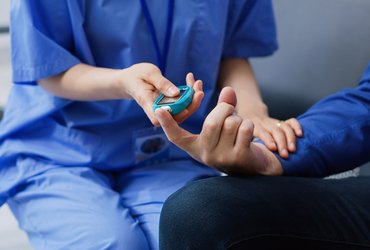

World Diabetes Day is an opportunity to reflect on what it means to live with and manage diabetes every day. I joined HSSIB as a safety investigator earlier this year, following a career in adult critical care nursing. As someone relatively new to national safety investigations, this work has given me a different perspective on the challenges of supporting people to self-manage their diabetes safely. We have recently completed a series of investigations focused on self-administration of insulin in the community and in this blog, I share a few of my reflections.
It’s not just about insulin
When HSSIB began investigating incidents associated with self-administration of insulin, I expected the focus to be on the administration of a high-risk medication. However, the more we involved people in the investigations, the more we realised that the challenges they face extend far beyond insulin alone. Patients, families and healthcare staff highlighted the many factors that influence how people manage their diabetes.
People with diabetes make multiple decisions each day, we place a lot of responsibility on people to self-manage their diabetes, without necessarily asking whether the conditions are in place to enable them to do so safely.
This made me reflect on how important independence can be, and how easily it can be lost when someone becomes unwell or their circumstances change. Providing the right support can help people develop, maintain, or regain the skills to self-manage safely, promoting choice, control, and wellbeing while reducing demand on community services. For me, this reinforced the importance of recognising people’s strengths and asking what could enable them to do as much as they safely can for themselves.
It’s not just about now
The investigations considered the experiences of people living with mental health problems, people with disabilities or impairments, and people with a learning disability. Their circumstances differed, and I reflected on the importance of truly understanding and meeting each person’s needs to empower and enable them to self-manage their diabetes safely. I was also struck by the population’s increasing needs and the described ‘avalanche’ of demand ahead, as more people live longer with diabetes, disabilities and impairments.
At present, forward planning is limited, both for individuals care and the needs of the changing population. Healthcare practitioners need to regularly ask: ‘What would help this person continue to manage their insulin and diabetes safely, now and in the future?’ The NHS needs to consider: ‘How will we meet the future needs of a changing population?’ Our investigations therefore made strategic-level recommendations to influence the design of future care.
Technology can help, but only if people can safely access it
Technology and medical devices were areas that the investigations repeatedly returned to and formed a theme in the final report. Diabetes technology has huge potential to help people live more independently and manage their diabetes effectively, but only if they can access it and receive the support they need to use it safely. I recognise that technology will not be the best or safest approach for everyone, but I reflected on how innovation and inclusion are often disconnected. This disconnect can deepen existing inequalities, creating additional barriers for people who may already face challenges in accessing the care and support they need. The investigations therefore made recommendations to support a more inclusive approach.
No single service has all the pieces of the jigsaw
Perhaps one of my strongest insights from this work was the importance of connections and collaboration between healthcare services. The investigations described the variety of services involved in care, including diabetes, mental health, learning disability, primary care and community services. However, I reflected that when a person’s needs do not fit within a single service, their care may be negatively affected. The stories of Alex and Megan, told in our report, demonstrated how gaps in care can emerge when people need support across multiple services, including mental health and specialist diabetes services. You can read more about their stories in our report focused on mental health
As a safety investigator, looking across care boundaries can reveal things that are harder to see from within a single service. No single service holds all the pieces of a person’s care, nor will it necessarily see the impact when services do not work together. The person, however, experiences a disjointed care journey that can significantly affect their mental and physical health. The investigations made recommendations to support collaborative care planning, particularly through future neighbourhood models.
The questions I am left with
Looking back across our investigations, there is no single or simple answer to making self-administration of insulin or self-management of diabetes safer. Instead, the investigations have highlighted the need for national support to create the conditions for safer care. I am also left with the following questions that I hope healthcare organisations and professionals will reflect on:
- Are we designing care around the person, or asking the person to fit the care available?
- Are we asking what somebody needs to enable safe self-management, or are we making assumptions about what they can do?
- As healthcare technology changes, are our services, workforce and devices evolving with it in an inclusive way?
Safe self-management is not simply about whether someone can administer their insulin. It is also about whether services have the capability and capacity to meet the person’s needs. I invite you to read HSSIB’s investigation series and use the learning to start your own conversations about what safe, equitable and person-centred support for self-management of diabetes should look like.
Read the series of reports Cherry references in the blog
- Insulin: supporting safe self-administration for patients in the community with a mental health problem
- Insulin: supporting safe self-administration for patients in the community with a disability
- Insulin: supporting safe self-administration for patients in the community with a learning disability
- Insulin: supporting safe self-administration for patients in the community - inequalities in technology and access to care
Find out more about World Diabetes Day
Related articles
Life-threatening gaps in community support for people with disabilities managing insulin
Read article