About this learning resource
Type: video lecture
Audience: Learners with roles in healthcare safety investigation, including investigation, commissioning, oversight and involvement.
Duration: 8 minutes
Objectives: By the end of this resource, you will be able to:
- Understand why you would use SEIPS in an investigation.
- Explain the elements of the SEIPS framework in their relation to a patient safety event.
- Justify the use of SEIPS as part of a safety investigation.
Watch the video
Competency mapping
Includes introduction to the following competencies [1]:
- 22.1 Uses human factors and ergonomics/safety science informed methodologies (i.e. models, frameworks, thinking or principles) to guide the design and conduct of an investigation.
- 25.1 Demonstrates the use of investigation principles, chosen framework and methods to undertake a systems based analysis.
- 25.3 Explores interactions, identifies emergent themes, and determines implications of findings across the work system.
[1] Lim, R., Hide, S., et al. (2026) Development of a competency framework for healthcare safety investigators: a modified e-Delphi study. Safety Science, 198, 107161. DOI: 10.1016/j.ssci.2026.107161
Further reading
- Holden et al, (2013) – SEIPS 2.0: a human factors framework for studying and improving the work of healthcare professionals and patients
- Holden and Carayon (2020) – SEIPS 101 and seven simple SEIPS tools
- HSSIB – Sepsis: investigating under the Patient Safety Incident Response Framework
- HSSIB – Unintentional overdose of morphine sulfate oral solution
- HSSIB – The investigator's toolkit: SEIPS
Key images
The Systems Engineering Initiative for Patient Safety (SEIPS)
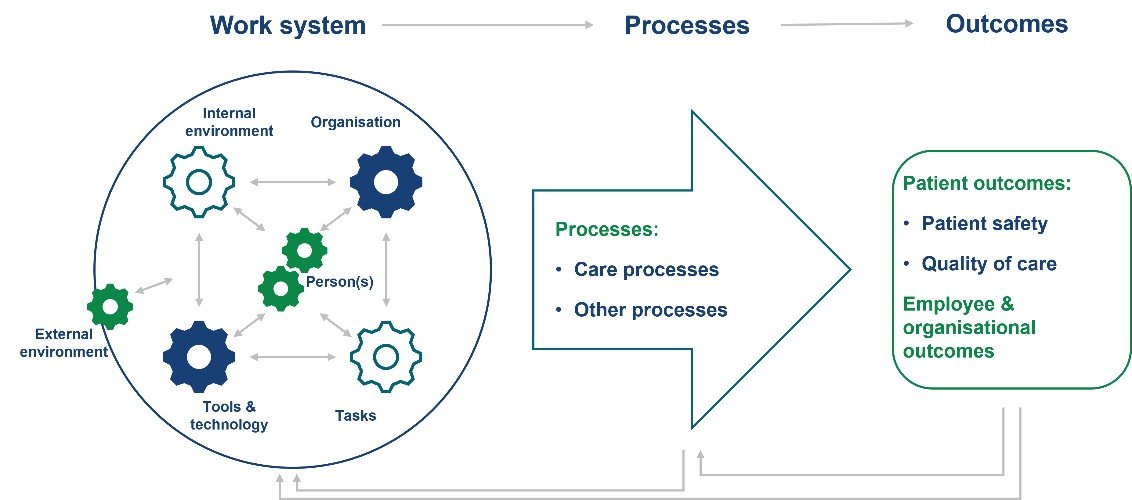
Adapted from Holden et al, (2013) – SEIPS 2.0: a human factors framework for studying and improving the work of healthcare professionals and patients