About this Learnng Resource
Type: video lecture
Audience: Learners with roles in healthcare safety investigation, including investigation, commissioning, oversight and involvement.
Duration: 8 mins
Objectives: By the end of this resource, you will be able to:
- Describe what is meant by a systems-based investigation.
- Justify the use of systems-based frameworks to support analysis.
- Discuss the principles of counterfactual reasoning and local rationality.
Watch the video
Competency mapping
Includes introduction to the following competencies [1]:
- 4.2 Understands the fundamentals of a systems approach, investigation methodologies and methods, and of engaging people.
- 17.1 Understands systems thinking and why it is needed within investigations in complex healthcare systems.
- 18.5 Counterfactual reasoning (what could or should have happened) is not the final outcome of an investigation; the focus is on understanding the work system.
- 18.6 Exploring local rationality (the influence of situation and context on decisions and actions) is key to understanding why work differs from what was expected.
[1] Lim, R., Hide, S., et al. (2026) Development of a competency framework for healthcare safety investigators: a modified e-Delphi study. Safety Science, 198, 107161. DOI: 10.1016/j.ssci.2026.107161
Further reading
- Macrae (2025) – Thinking and organising in systems: reframing the long problem of learning from incidents
- Sampson et al. (2021) – Systems-based models for investigating patient safety incidents
- Humanistic systems – The varieties of human work
- Monash University – CARe-QI: a handbook for improving quality through resilient systems
- HSSIB – Learning response review and improvement tool
Key images
Varieties of human work
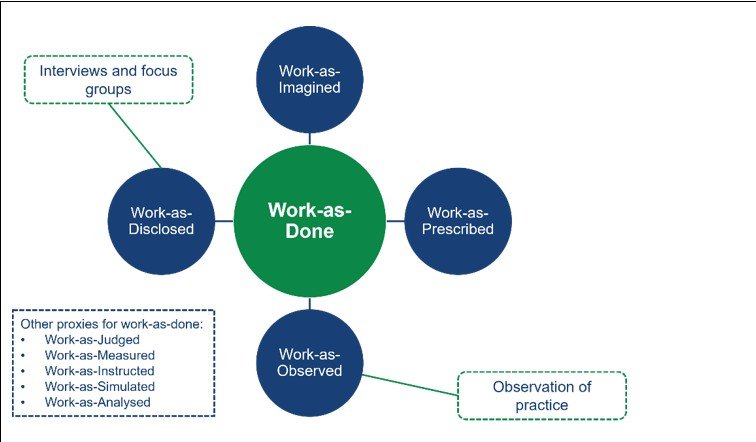
Adapted from Humanistic systems – The varieties of human work
CARe-QI
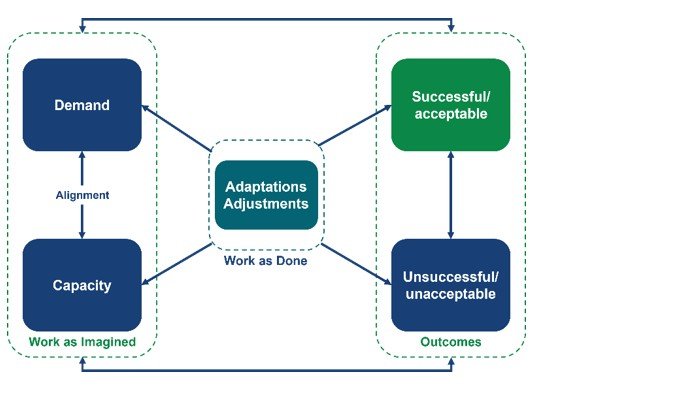
Adapted from Monash University – CARe-QI: a handbook for improving quality through resilient systems