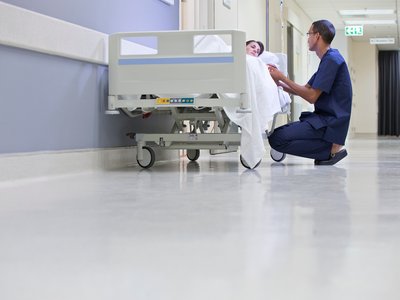
This investigation explores the management of patient safety risks associated with using temporary care environments, often referred to as ‘corridor care’ and ‘temporary escalation spaces’. These are spaces not originally designed, staffed, or equipped for patient care (such as corridors, waiting rooms and chairs on wards). System-wide management of patient safety involves primary care, ambulance services, hospitals, community services and social care, and relies on effective patient flow. Temporary care environments are being used regularly due to pressures with patient flow where demand exceeds capacity. Their use requires a difficult compromise in patient experience, including privacy and dignity, in the interests of sharing risk and supporting patient safety.
This investigation specifically looked at acute hospitals in England, focusing on the patient safety aspects associated with the use of temporary care environments and how patient safety was being mitigated. The report explores how, where, when and why temporary care environments are used, what the associated patient safety risks are, and the impact on patients and staff.
This investigation is set against the context of challenges around demand, capacity and patient flow in the health and care system and did not focus on the wider factors which influence the need to use temporary care environments. This was due to the timescales and boundaries which the investigation was working to. Some of the factors that were not explored were internal and external processes that support the timely discharge of patients or patients who had been assessed as no longer needing to be in hospital. HSSIB's predecessor, the Healthcare Safety Investigation Branch (HSIB), has previously explored the flow of patients through and out of hospitals and made safety recommendations to the Department of Health and Social Care.
The investigation observed the actions trusts were taking to mitigate the patient safety risks associated with temporary care environments. These risks included difficulty monitoring patients, insufficient staff for satisfactory staff to patient ratios, infection risk, a lack of piped oxygen and suction, and compromised response to medical and fire emergencies. The investigation observed the adaptations made in areas including staffing, the environment, equipment, and delivery of care.
The investigation was carried out between August and December 2025, recognising pressures around patient flow are constant and that temporary care environments are used throughout the year and not just during ‘winter pressures’. The investigation was carried out within a short time period so that learning could be shared with acute hospitals about what can be done to reduce patient safety risks and immediate harm when using temporary care environments. The investigation was therefore limited in its scope. It draws on observations from multiple hospitals and discussions with national stakeholders.
The findings in this report relate to the hospitals that the investigation engaged with. It recognises that this is a sample and there may be further variation across the health and care system and at different times of year.
- All staff the investigation engaged with were motivated to make things as good as they could for patients. There was a strong desire not to have to use corridor care (one form of temporary care environment).
- There was inconsistent data and information gathering which meant the impact of temporary care environments on patient safety may be poorly understood.
- There were limited reported patient safety incidents where the temporary care environment itself was recorded as a factor.
- National and local data on the time patients are in a temporary care environments is variable and inconsistent.
- There is variation in the language used to describe temporary care environments at a provider level. This can cause inconsistency in how national policy is applied, this impacts the findings above.
- There was governance processes associated with the use of temporary care environments. These include evidence of risk assessments to identify areas that can be used as temporary care environments, and to identify patients who may be more suitable for care in these spaces.
- Temporary care environments were located across hospital estates, in emergency departments and in ward areas. They included beds and trolleys in corridors, upright and reclined seating areas, extra spaces being made on wards or in cubicles, and other converted spaces, for example side storage rooms, office spaces and family rooms.
- Trusts were making adaptations and adjustments to the environment, staffing and delivery of care where possible to mitigate patient safety risks when using temporary care environments.
- Staff described feelings of moral injury (negative emotions that arise because they cannot provide the level of care they would like) caused by having to care for patients in temporary care environments and the resulting compromise in patients’ experience.
- There are patient safety risks that are more challenging to manage when using temporary care environments including medical emergency situations, fire safety and infection prevention and control.
- There is varied understanding of what quality of care (including patient experience) is compared to patient safety at all levels of the healthcare system.
- Concerns around normalising the use of temporary care environments can present a barrier to trusts putting all the possible patient safety mitigations in place when using temporary care environments.
- Improving patient flow would reduce the need to use temporary care environments.
- There was evidence of increased awareness by most hospital staff of pressures across the health and social care system including primary care, ambulances and social care. There was a recognition of the need to work together to share and mitigate risks to patient safety.
- There are internal processes that hospitals can improve to support functions that assist timely discharge, including using multidisciplinary teams in complex discharge processes.